Awaab’s Law Excess Cold: What Thermography Can Evidence
From 30 November 2026, the Awaab’s Law duties on social landlords in England stop being only about damp and mould. The Hazards in Social Housing (Prescribed Requirements) (England) (Amendment) Regulations 2026 bring excess cold onto the same clock, alongside excess heat, falls, structural collapse, fire and explosions, electrical hazards and domestic hygiene.
Excess cold is harder to evidence than visible mould. A tenant reports that a bedroom never gets warm, the heating engineer finds the boiler and radiators working, and the investigation stalls somewhere between the thermostat and the walls. The regulations still expect a competent investigator to complete an investigation within 10 working days of the landlord becoming aware of the issue, and the tenant to receive a written summary within 3 working days of that investigation. A thermographic survey in the heating season looks directly at the building fabric: where heat leaves through missing or slumped insulation, where cold bridges form at lintels and junctions, and where air leaks around windows and doors. It records what the surfaces were doing, under conditions that are written down, so the investigation can show it examined the home itself and not only the heating system.
This post is for social landlords, housing associations and managing agents with an Awaab’s Law clock running. It explains what changes on 30 November, what an excess cold investigation needs to show, and where thermography fits. It also sets out what a survey cannot tell you, so the evidence is never asked to carry more than it can. A thermographic survey is one way to evidence that investigation; the law names no technique and no qualification.
Awaab's Law Excess Cold: What Thermography Can Evidence
From 30 November 2026, excess cold joins the Awaab's Law clock for social landlords.
Evidencing an Excess Cold Investigation
What changes on 30 November 2026
Phase 1 of Awaab’s Law, the Hazards in Social Housing (Prescribed Requirements) (England) Regulations 2025, SI 2025/1042, came into force on 27 October 2025 and covered damp and mould and all emergency hazards. Phase 2 widens the list of relevant hazards to further matters in Schedule 1 of the Housing Health and Safety Rating System (HHSRS) regulations. Excess cold is the one that matters most to a thermographer, because it is a property of the building fabric as much as of the heating.
The amendment also changes how a significant hazard is recognised. It becomes one that a reasonable landlord with the relevant knowledge would make safe within 15 working days. Emergency hazards still sit on a 24 hour clock. The investigation and written summary duties of the 2025 Regulations, 10 working days and 3 working days, now reach the wider list.
The duties apply to social landlords in England. They do not apply to private landlords, owner-occupiers, leaseholders or shared owners today.
Why excess cold is hard to evidence
Mould can be photographed. Cold usually cannot. A tenant describes a room that never warms, condensation on a north wall, or a draught they can feel but nobody can see, and the first visit is often a heating engineer, who quite properly checks the boiler, the controls and the radiators. If they are working, the complaint can stall. The question the investigation still has to answer is why the room is cold when the heat is being delivered.
The answer is usually in the envelope. Insulation that was never fitted, has slumped in a cavity or been disturbed in a loft. A concrete lintel or floor slab running from inside to outside. Gaps around a replacement window, or an air path through a service penetration. None of these is visible on a decorated wall, and all of them change the temperature of the surfaces around them.
What a heating-season thermal survey examines
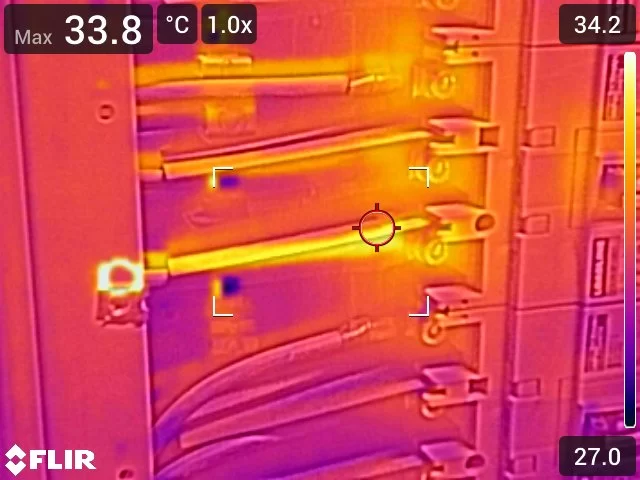
A calibrated radiometric thermal camera records the surface temperature of every point in its frame. On a heated home on a cold morning, the outside surface over a missing patch of insulation reads a little warmer than its surroundings, because more heat is passing through it, while the inside surface over the same patch reads a little cooler. A cold bridge shows as a line or band that follows the structure. Air leakage draws a feathered, directional pattern around the gap it comes through.
Each thermal image is taken with a matching visual photograph of the same view, so every pattern can be tied to a location on the building and to what is physically there. Outside, the survey covers each elevation square on. Inside, where access is given, it covers the rooms the tenant has reported. The same method sits behind every thermal imaging house inspection we carry out; under Awaab’s Law the difference is the record it has to support.
The conditions that make the images evidence
A thermal image is only as good as the conditions it was taken in, and this is where many surveys fail. The patterns described above appear only when there is a steady temperature difference across the wall. Our method asks for at least 10 °C between inside and outside, held for at least 12 hours, with the heating on and the home closed up. No sun can be falling on the surveyed faces, so the survey runs before sunrise or around two hours after dark.
Those conditions are measured and written down at the time, with the camera settings used. That matters twice over. It lets anyone reading the report judge how far the images can be relied on, and it lets a second survey, after works, be compared with the first on equal terms rather than on the weather. A survey taken on a mild, sunny afternoon may produce colourful pictures, but it says very little about excess cold.
What the survey cannot tell you
Thermography is a qualitative method. It identifies surface temperature patterns that are consistent with heat loss, missing or wet insulation, thermal bridging or air leakage. It does not measure a U-value, it does not see inside the wall, and it does not by itself confirm the cause behind a pattern without corroborating investigation.
Nor does it classify the hazard. Under the regulations the landlord retains responsibility for deciding whether a significant or emergency hazard exists. A thermographic report gives that decision evidence. Findings point to the right trade, an insulation installer, a glazing contractor or a heating engineer, and never prescribe the repair.
Fitting the survey to the clock
The 10 working days run from the day after the landlord becomes aware of the issue, and the heating season is short. A survey therefore works best when its conditions are planned at the first report, not after a first visit has drawn a blank. Overnight forecasts are checked for the temperature difference, the tenant is asked to keep the heating running and the windows closed beforehand, and the visit is booked for an early morning or an evening.
The output is built to feed the written summary the tenant must receive. It records where the cold surfaces are, what they are consistent with, the conditions on the day, and what further investigation would confirm the cause. Where an investigation can be completed remotely or from photographs, the landlord may choose to do that; a survey adds weight where the cause is not obvious.
Damp, mould and cold in the same home
Excess cold and damp are often the same problem seen from two sides. A cold inside surface falls below the dew point of the room air, condensation forms, and mould follows. A home reported for mould under phase 1 may now also carry an excess cold question under phase 2, and one survey in the right conditions can examine both. Our damp and mould survey explains how surface temperature, air temperature and humidity are read together to separate condensation from penetrating or rising damp.
Who stands behind the findings
The regulations ask for a competent investigator, a person with the skills and experience to determine whether a home is affected by a hazard, and leave that judgement to the landlord. Every report is written and certified by our Level 3 thermographer, with the method, the conditions and the limits of the evidence stated, so it can sit in the investigation record and be read by a tenant, a surveyor or the Housing Ombudsman without anyone having to guess what was measured.
Awaab's Law Phase 2 Guidance
Government guidance for landlords
The government’s phase 2 guidance for social landlords explains how Awaab’s Law widens from 30 November 2026. The amending instrument, the Hazards in Social Housing (Prescribed Requirements) (England) (Amendment) Regulations 2026, adds excess cold, excess heat, falls, structural collapse, fire and explosions, electrical hazards and domestic hygiene to the hazards already covered by the 2025 Regulations, and it applies to social rented housing only. The amendment also recasts a significant hazard as one that a reasonable landlord with the relevant knowledge would make safe within 15 working days. Guidance of this kind is non-statutory: where it says a landlord should do something, that is good practice, and where the regulations say must, that is the duty. Read it alongside SI 2025/1042, the phase 1 regulations, which set the investigation and written summary timescales that phase 2 builds on.
Book a Heating-Season Survey
If an excess cold report has started an Awaab’s Law clock on one of your homes, talk to us at the first report rather than after a first visit draws a blank. We will plan the survey around the forecast and the tenant, capture the fabric under recorded conditions, and deliver findings shaped to support your investigation and the written summary. Every report is written and certified by our Level 3 thermographer. Tell us about the property and the timescale.