
Thermal Product Testing and Thermal Imaging Product Validation
Controlled thermographic product testing for manufacturers and developers, from emissivity to heating performance, certified by a Level 3 thermographer.
Thermal product testing gives manufacturers and product developers measured evidence of how a product or material behaves thermally: what its surface emissivity is, how evenly it heats, how quickly it responds and how it performs across its working range. That evidence supports design decisions, product claims and the guidance you give customers.
Thermography Services (UK) runs controlled thermographic product testing in its own studio, with every test designed before any measurement is taken and every result stated with the conditions it applies to. Emissivity testing and heating product validation can be run separately or together. Every report is written and certified by our Level 3 thermographer.
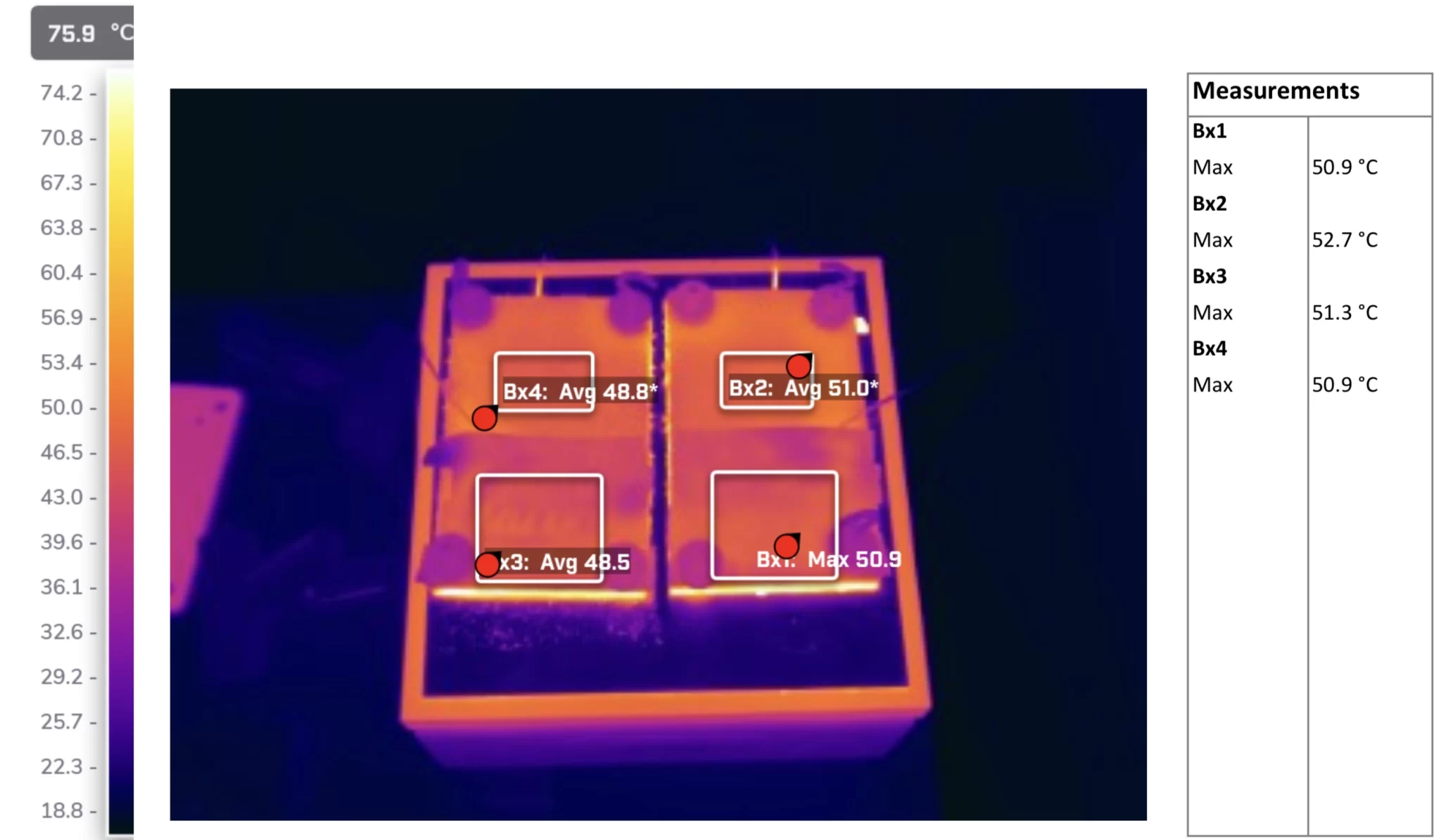
Measured thermal evidence for your product, designed, tested and reported to stand up to scrutiny.
Products are increasingly sold on thermal performance. A heating panel promises even warmth, a coating promises to reflect or hold heat, an insulation product promises to keep it in, and a new material promises to do something better than the one it replaces. Customers, specifiers and distributors want to see the evidence, and development teams need it long before the product reaches them. Thermal imaging is one of the clearest ways to provide it, because it shows the whole surface at once and turns heat into a picture anyone can understand. The difficulty is that a thermal camera is easy to point and hard to read. Without the right emissivity, a controlled environment and a method fixed in advance, the picture can look convincing and still be wrong.
Product testing closes that gap. Each test is designed around a single clear question, run under controlled conditions in our studio and analysed by a Level 3 thermographer, so the result can be shown to be right rather than simply asserted.
The service covers two main types of work. Emissivity testing measures the emissivity of a surface so that thermal cameras read it correctly, which matters for any product that will be inspected, tested or marketed with thermal imaging. Heating product thermal validation records how a heating product warms, how evenly it spreads its heat and how it responds to its power input. The two can be combined in one programme. The certified report sets out the method, the results and their limits, so your team can act on it and your customers can trust it.
Controlled thermographic product testing for manufacturers and developers, from emissivity to heating performance, certified by a Level 3 thermographer.
Page Subjects
thermal product testing, thermographic product testing UK, thermal imaging product validation, product thermal performance testing, thermography for product development



Page Tags
product testing, thermal imaging, emissivity, heating products, product development, manufacturers
Request a Product Testing Quotation
Every product test is designed around the product, the question you need answered and how the result will be used. Tell us what the product or material is, what you want to know about its thermal behaviour, how many samples or finishes are involved and whether the results will support development, a technical file or a product claim, and we will come back with a clear proposal and a quotation for the work, covering both services where they apply.
Why products need controlled tests
Thermal Evidence You Can Defend
Thermal imaging is often used informally in product development. Someone points a camera at a prototype, takes a picture and shares it. That picture can be useful, but it is not evidence anyone else can rely on.
Three things decide whether a thermal image of a product means what it appears to mean. The first is emissivity: unless the camera is given the right value for that surface, the temperatures it shows are not the temperatures of the product. The second is environment: room temperature, air movement, reflected heat from nearby surfaces and even the person holding the camera all change the reading. The third is method: if the test was not planned before it started, there is no way to show that the result was not shaped by the way it was run.
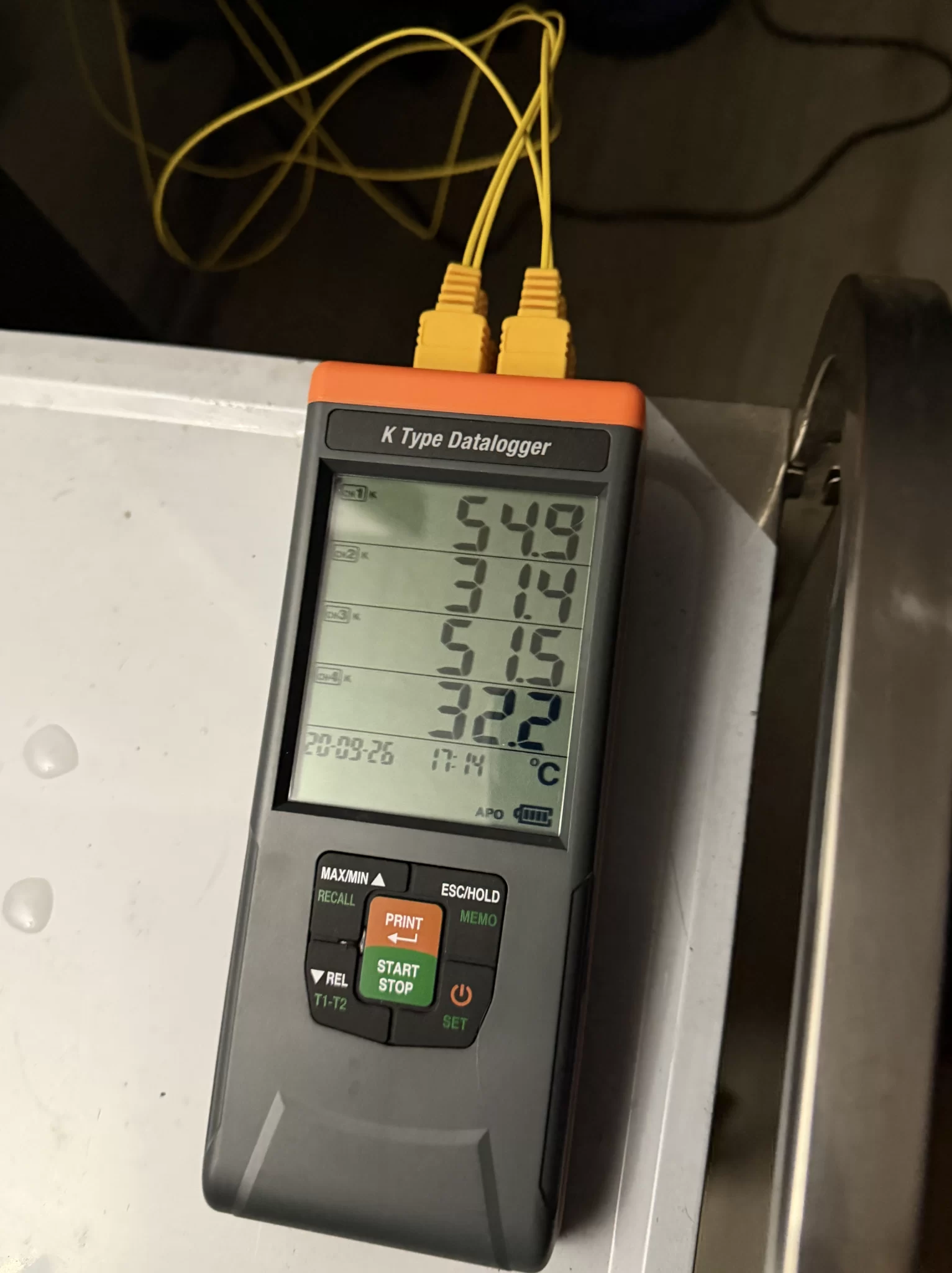
Controlled testing deals with all three. Surface emissivity is measured rather than assumed. The test runs in a controlled studio with air conditions logged and the reflected temperature measured. And the method is written down and fixed before any measurement, with anything that changes on the day recorded as it happens. Contact thermometers on the surface give an independent check on what the camera shows.
The result is a test, not a snapshot.
That difference matters most when the evidence will be used outside the development team: in a technical file, a specification sheet, a tender response, a conversation with a distributor or a marketing claim. Each of those audiences may ask how a figure was obtained, and a certified report that sets out the method, the conditions and the limits of the result answers that question before it is asked.
It also makes the next test easier. Because each test is documented in enough detail to be repeated, a later prototype, batch or finish can be tested the same way and compared directly with the first, building a record of how the product has developed.
Who product testing is for
Manufacturers, Developers and Research Teams
Product testing is for organisations that make, develop or specify products where heat matters: manufacturers of heating products, coatings, insulation and building products, developers of graphene and other advanced materials, and research and development teams in industry and academia. Many already use thermal imaging themselves and want a test that will stand up when the results leave the building.
The trigger is usually a question that needs a measured answer. What emissivity should our installers set on their cameras? Does the new design heat more evenly than the old one? At what setting does the product perform best? Is the uneven pattern a customer has reported down to the design? Each of those questions can be answered with images and data, provided the test is designed for it.
Each programme starts with that question, written in one sentence. From it come the samples, the conditions, the methods and the report. Where the answer needs more than one test, the tests are combined into a single programme with one report, so emissivity and heating performance can be covered together, using the same samples where possible.
Testing is offered to clients across the UK and internationally, with the scope agreed in writing before any samples are prepared.
Case Study
Graphene Underfloor Heating Panel Performance Test
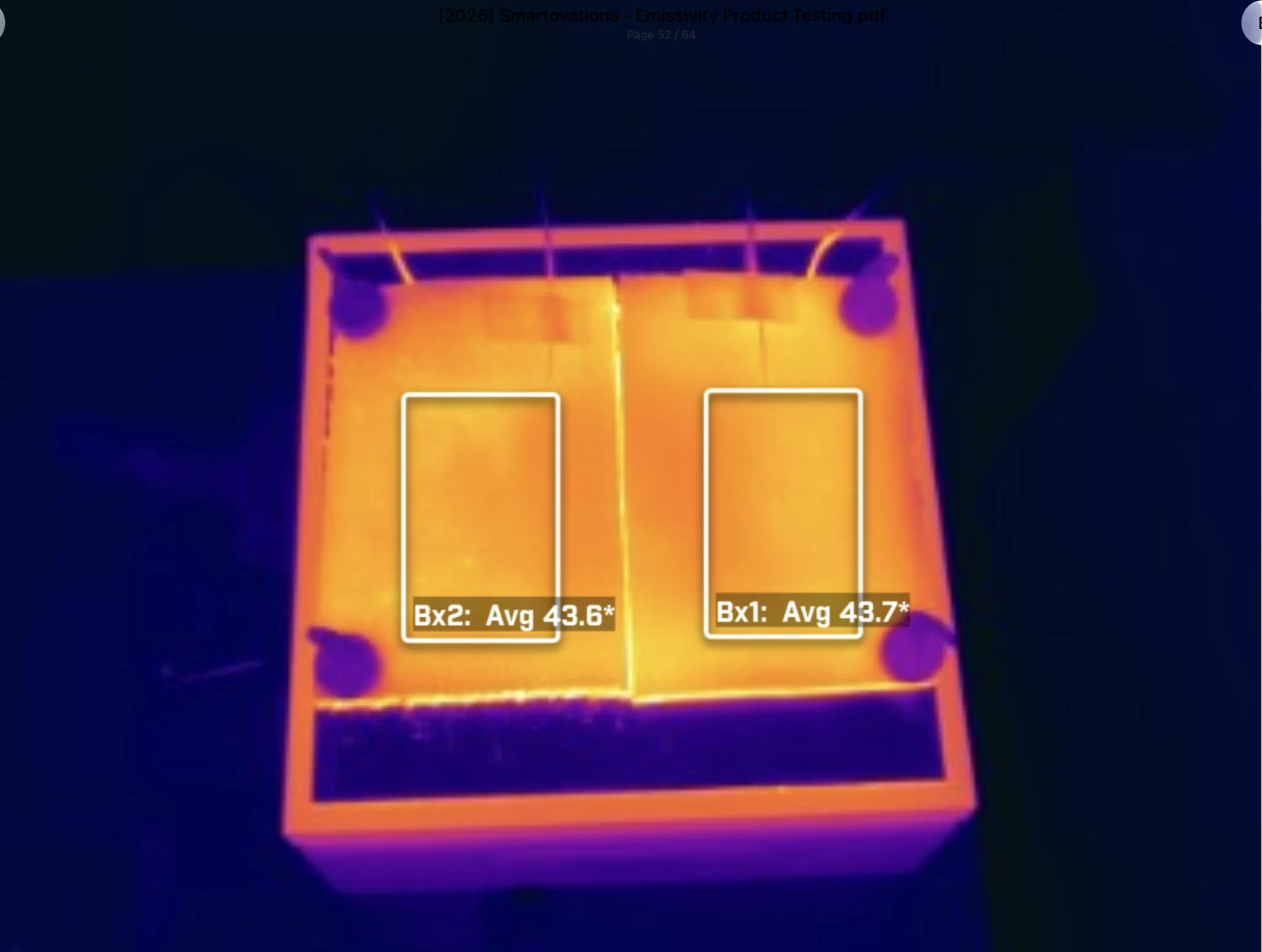
A product developer needed independent evidence of how its graphene-based underfloor heating panel performed across its range of supply voltages. Under controlled conditions, the panel was run in steps from 8 V to 48 V while power input and surface temperature rise were logged and thermal images recorded. The panel delivered its best temperature rise per watt between 20 V and 30 V, and heated uniformly with no cold spots or discontinuities detected. The certified report gave the developer a recommended operating range backed by measured data.
Standards and Certification
Thermographic inspection, analysis and reporting are carried out by a Thermography Services (UK) ITC Level III Certified Master Thermographer (Infrared Training Centre; Certification #205722059), practising in accordance with the frameworks of ISO 18436-7:2014, ASNT SNT-TC-1A and ANSI/ASNT CP-105, and BINDT CMGEN Appendix B (UK training governance). Inspection methodology is aligned with IEC 62446-3:2017 (solar PV) and BS EN ISO 6781-1:2023 (building envelopes) as applicable.
Thermographic Product Testing UK
What thermal product testing covers
Thermographic product testing in the UK, as Thermography Services (UK) provides it, is controlled studio testing designed around a specific question and reported to a certified standard. Product thermal performance testing can include emissivity determination, surface temperature uniformity, warm-up and cool-down response, the time taken to reach a steady temperature and the temperature rise produced by each step in power input, on a single sample or across a range of designs, finishes or batches. Infrared testing of heating products is a frequent request, and so is emissivity testing of coatings, insulation and new materials. Testing is usually commissioned at one of three moments: during development, before a product launch, or when a question about performance arises once the product is in use.
Thermography for product development works best early. A thermal image of a prototype shows where heat goes, where it is lost and where it concentrates, so a design team can compare options while changes are still cheap to make. Later in the cycle, the same methods provide the evidence behind specification sheets, installation guidance and product claims, and give quality teams a reference for checking production samples against the approved design. Thermal imaging product validation then becomes part of how the product is described, rather than an afterthought.
Testing that stands up to scrutiny
Every test follows the same discipline. The question is agreed and written in one sentence. The test script, setting out the samples, conditions, methods and the checks that would invalidate a result, is fixed before the first measurement. The sample is tested in a controlled studio with air conditions logged and the reflected temperature measured, and contact thermometers check the thermal images. Every image is stored radiometric, every record is kept and the report gives enough detail for another competent thermographer to repeat the test from the documents alone. Where several samples are tested, they follow the same script, so their results can be compared directly.
Where the result is a number, such as an emissivity value, it is stated with its uncertainty, evaluated following the internationally recognised guide to uncertainty in measurement. Where the result is a pattern, such as the spread of temperature across a heating panel, the images and data are presented with the conditions they apply to. In both cases the report states plainly what the result shows, what it does not and the limits within which it holds.
Each programme is a product thermal imaging study carried out to a defined method, not a product certification, and it complements any formal heat output or safety testing a product standard sets. Results relate only to the samples tested under the conditions stated. This thermal testing service for manufacturers is available across the UK and internationally, and data your own team has already captured can be analysed and certified through our Level 3 report writing service.
Methods and Standards
The standards behind it
Every product test is run to a written test script, fixed before the first measurement, under the practice’s controlled test procedure. Emissivity is determined by the contact method and the reference emissivity material method in Annex A of ISO 18434-1:2008, the general procedures part of the international standard for thermography in condition monitoring, with reflected apparent temperature measured by its reflector method.
Measurement uncertainty is evaluated following JCGM 100:2008, the Guide to the Expression of Uncertainty in Measurement, so every determined value is stated with an expanded uncertainty and the conditions it applies to. Heating product tests are designed for each programme around the client’s question, using the same controls: a fixed script, logged conditions, measured reflected temperature, a determined emissivity and contact cross-checks, all recorded in every report. Standards are cited as the basis of the method.

Request a Product Testing Quotation
Every product test is designed around the product, the question you need answered and how the result will be used. Tell us what the product or material is, what you want to know about its thermal behaviour, how many samples or finishes are involved and whether the results will support development, a technical file or a product claim, and we will come back with a clear proposal and a quotation for the work, covering both services where they apply.


