
Electrical Distribution Board Thermal Inspection and Thermography Survey
Level 3 certified thermographic inspection of electrical distribution boards and panels, identifying abnormal heating that may indicate a developing problem.
An electrical distribution board thermal inspection records the surface temperatures of a board's incoming supply, busbars, protective devices and terminations while the installation is under load. Abnormal heating at a connection or device is one of the earliest visible signs that something is changing inside a board, often long before it shows any other symptom, which is what makes a regular survey such an effective early check.
Thermography Services (UK) carries out distribution board thermography surveys for commercial, industrial and public sector sites. Every image is analysed, classified by severity and consequence, and explained in a certified report written by our Level 3 thermographer.

Commercial Electrical Distribution Board & Panel Thermography Inspections
Abnormal heat inside a distribution board, found, classified and explained before it escalates.
Most problems inside an electrical distribution board give off heat before they give any other warning. A loose termination, an overloaded circuit or a protective device under strain will run warm while the board looks entirely normal from the outside. Distribution boards are where the load of a building concentrates, and a small fault at one termination can affect every circuit it feeds.
A thermographic survey makes that heat visible. With the board under representative load, a calibrated radiometric thermal camera records the surface temperature of every accessible component, and each one is read against a comparable reference on the same board, phase against phase and device against device, so a connection running warmer than its neighbours stands out clearly. The survey is non-intrusive and does not interrupt the supply. Offices, shops, schools and factories carry on working while it is done. By the time a fault announces itself with a smell, a nuisance trip or scorching, it has usually been developing for months, and the camera can often see it long before then. That early view is what turns an unplanned failure into a planned investigation.
The value is in the reading. Our Level 3 thermographer compares each anomaly with its baseline, takes account of load and access, and classifies it by severity and consequence. The certified report sets out what was found, what each finding is consistent with and which boards to look at first. Your electrical contractor gets a clear priority list, and your records show when each board was checked. Where a board cannot be opened safely, or a device is hidden behind a cover, the report records it, so you know exactly what the survey did and did not see.
Level 3 certified thermographic inspection of electrical distribution boards and panels, identifying abnormal heating that may indicate a developing problem.
Page Subjects
electrical distribution board thermal inspection, electrical distribution board thermography inspection, electrical distribution board thermal survey, electrical distribution board thermography survey, electrical distribution board thermal scan



Page Tags
distribution board thermography, electrical thermography, thermal imaging, electrical inspection, condition monitoring, insurance survey
Request a Board Survey Quotation
Every site is different, so every distribution board survey is scoped to the installation, the number and type of boards, access arrangements and the question you need answered. Tell us about the site, whether the survey is for maintenance planning or for your insurer, and any deadline you are working to, and we will come back with a clear proposal and a quotation for the work. If you already capture your own thermal images, tell us that too.
What a thermal image reveals
Why Boards Show Heat First
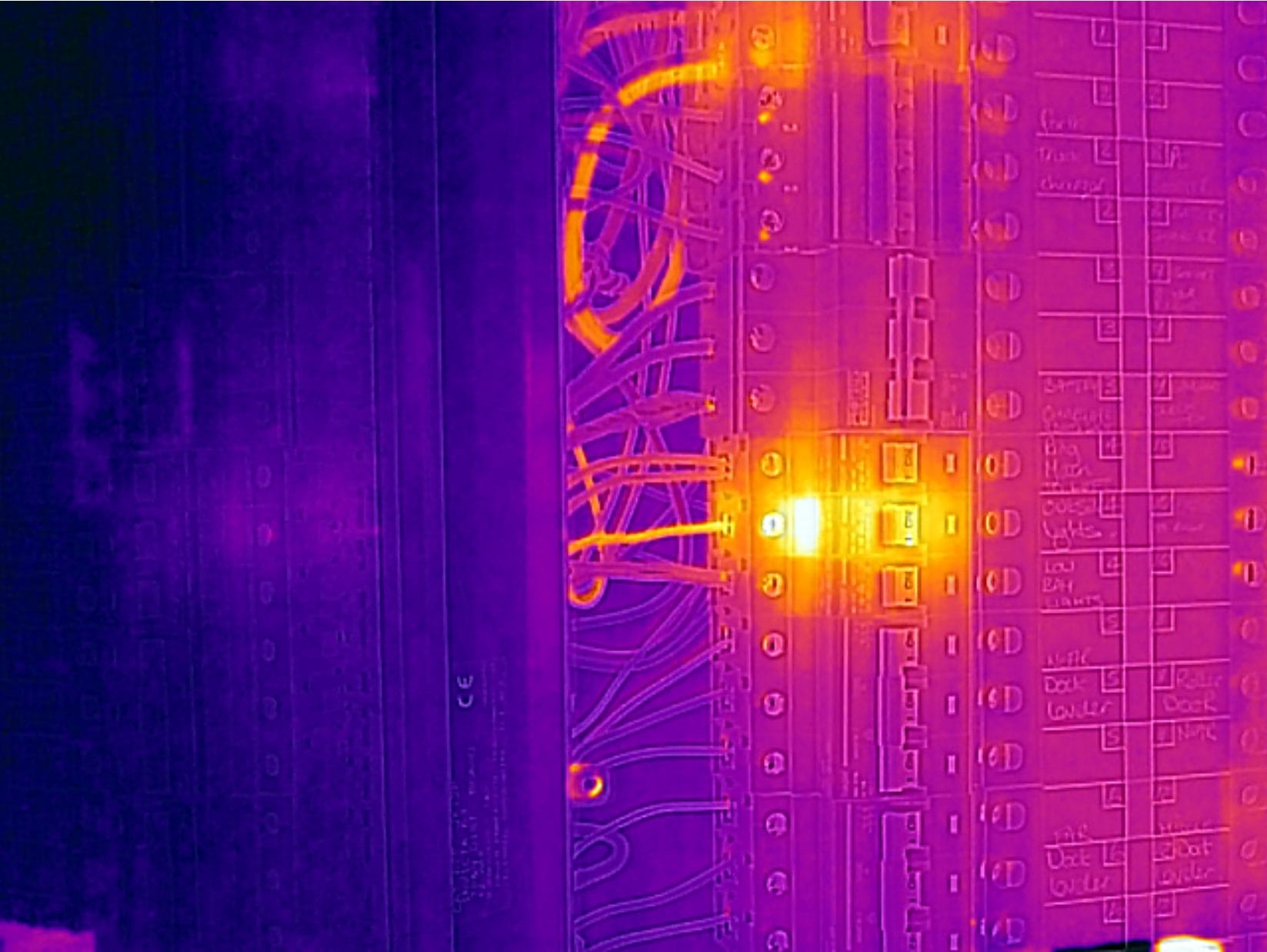
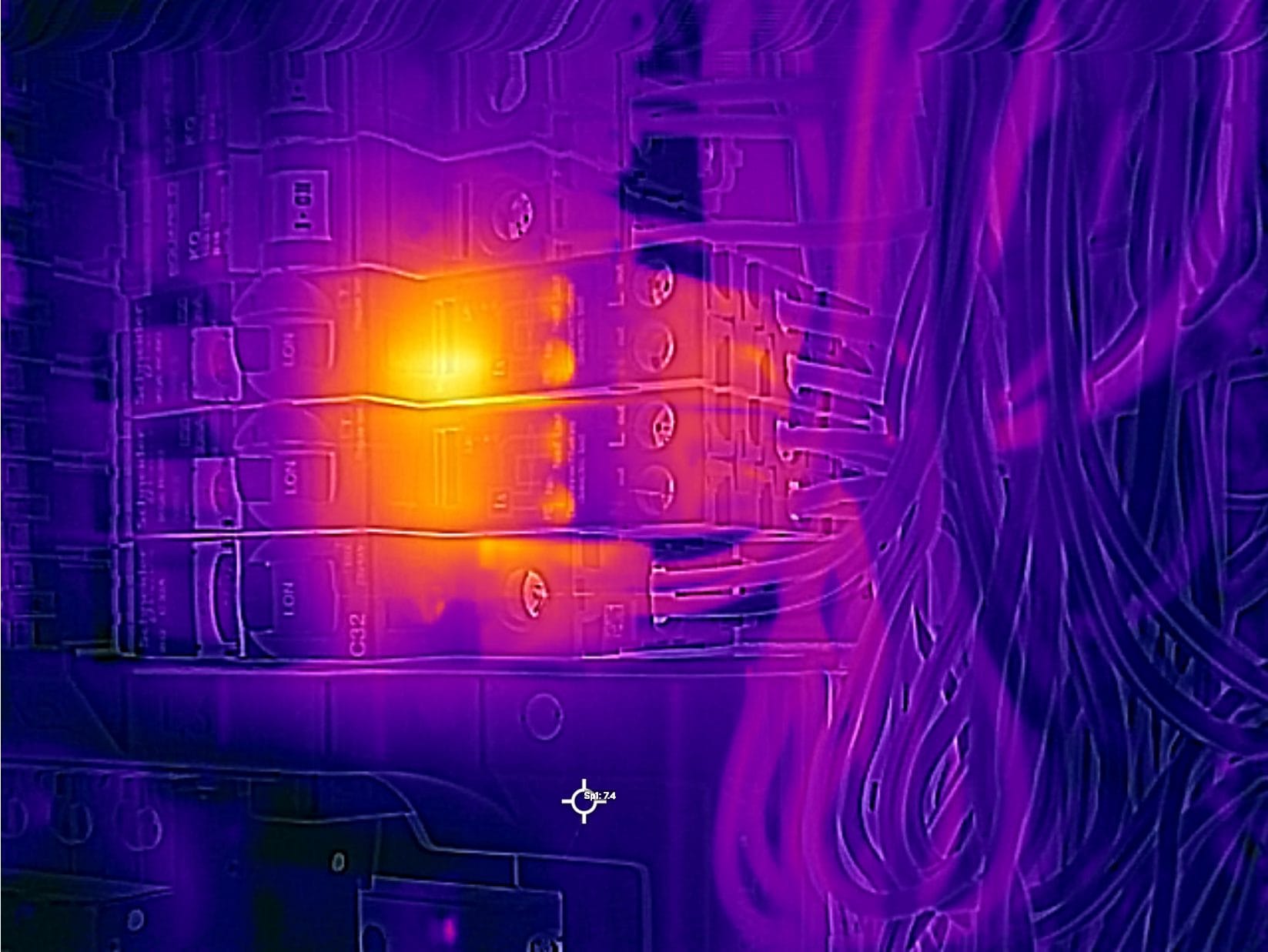
Electrical resistance turns current into heat. Where a connection loosens, corrodes or is poorly made, its resistance rises and so does its temperature, often well before it fails. The camera sees that rise as a warmer spot on an otherwise even board.
The causes are familiar to anyone who maintains electrical installations. Terminations relax over time as copper and aluminium expand and contract with each load cycle. Screws that were correctly torqued at installation can loosen with vibration. Oxidation builds at contact faces, cables are disturbed during alterations, and circuits are added to boards that were never designed for the load they now carry. Each of these raises resistance at a single point, and each shows as heat.
A thermographic survey compares like with like. Each phase is read against the other phases, each device against similar devices on the same board under the same load, so a component running warmer than its reference stands out clearly. That comparison is what separates a genuine anomaly from a part that is simply carrying more current.
Not every warm component is a concern. Some devices run warm by design, and a heavily loaded circuit will always be warmer than a lightly loaded one.
Imbalance tells its own story. Where one phase of a three-phase supply runs noticeably warmer than the other two at the main switch or busbars, the cause may be uneven load distribution across the board rather than a failing connection, and the report says which explanation the evidence supports. A neutral conductor running warm can point to unbalanced or non-linear loads, which matters on boards serving lighting, computers and other electronic equipment.
Reading the pattern, the location and the load together is what turns an image into a finding you can act on, and it is why every image is reviewed and classified rather than simply flagged.
Related Electrical Thermography Services
How a board survey is run
Load, Access and the Baseline
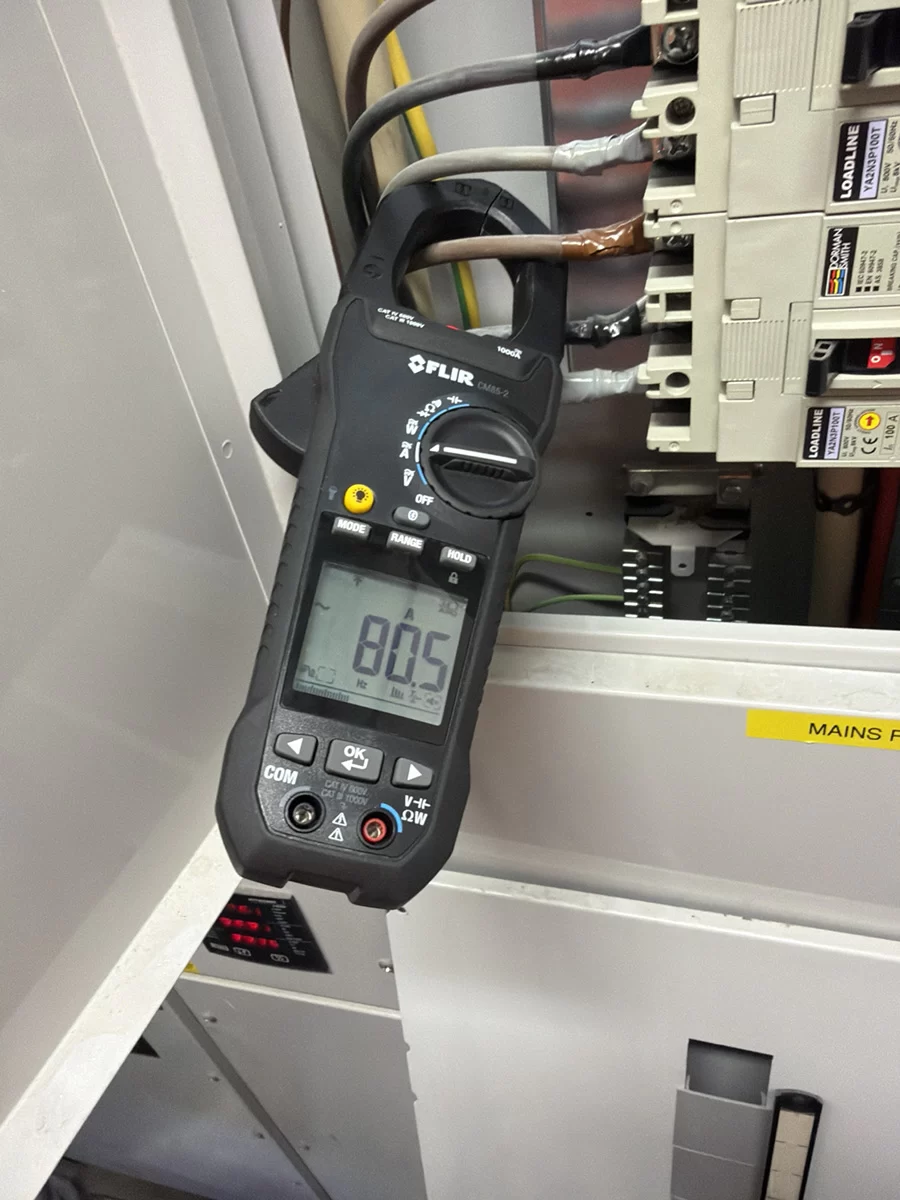
A distribution board survey only means something if the board is working. Boards are surveyed under representative operational load, and the load is recorded at the time of capture, because a lightly loaded circuit can hide a problem that would show clearly at full demand.
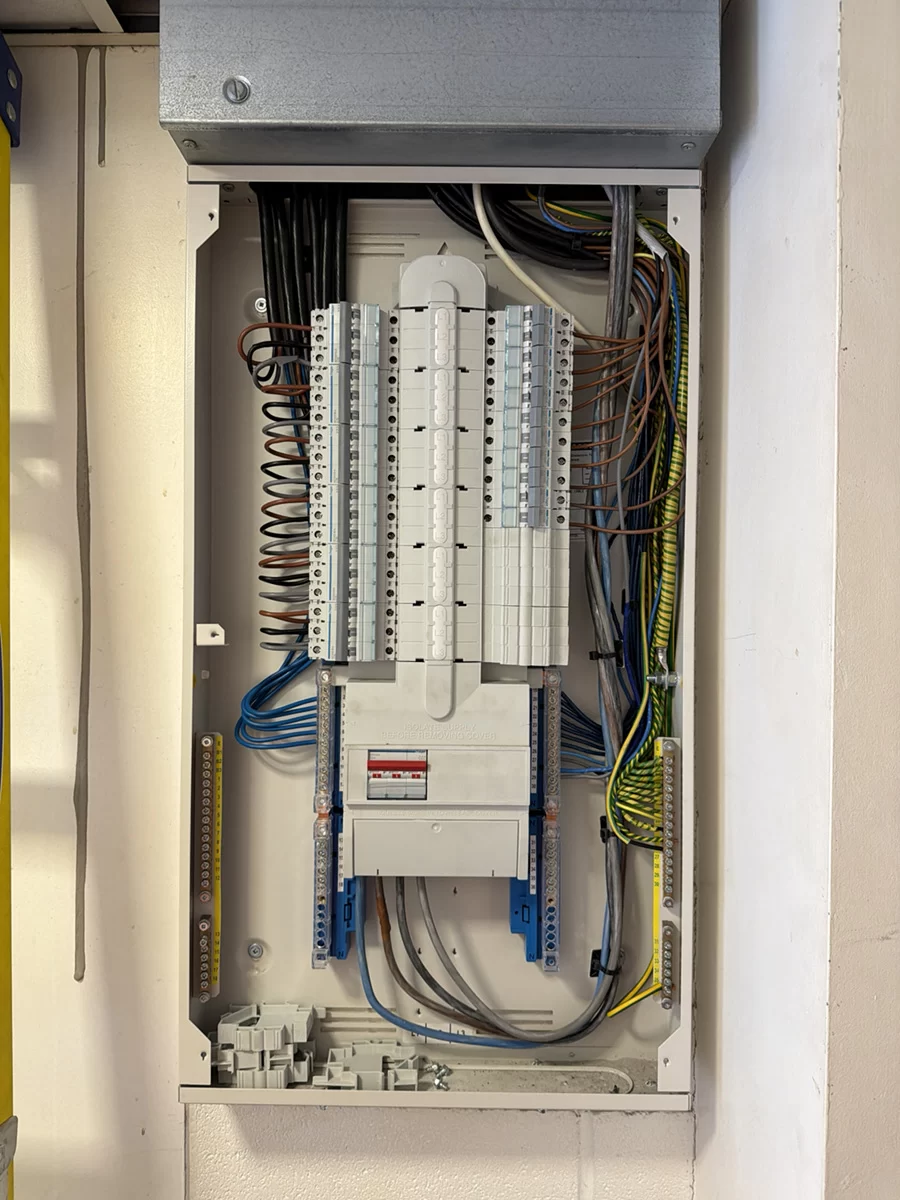
Access matters as much as load. Boards are surveyed covers-off where it is safe and permitted to do so, under a documented safety protocol, with the covers removed by the client’s authorised person. That exposes the terminations, conductors and busbars directly. Where covers must stay on, the device fronts and cover surfaces can still be assessed, and the report states clearly what could and could not be seen.
Every board is read against a baseline: a comparable, evenly loaded component on the same board, imaged under the same conditions. Temperature differences are measured above that baseline rather than judged by eye, and the radiometric settings for each image are recorded so the result can be checked.
Conditions, load, access and every limitation are stated in the report, so anyone reading it later, including your insurer or a future surveyor, can see exactly what each finding rests on and how far it can be relied upon.
Case Study
Distribution Board Survey for an Insurer's Programme
An insurance-led electrical thermography survey across seven commercial distribution boards, commissioned to assess fire risk and operational integrity as part of the client’s insurer risk programme. Every board was imaged under load and analysed at Level 3. The survey found predominantly stable thermal performance, with one advisory-level observation on a residual current breaker that was consistent with load conditions, and no critical anomalies. The certified report gave the client documented evidence for its insurer and a baseline for future surveys.
Standards and Certification
Thermographic inspection, analysis and reporting are carried out by a Thermography Services (UK) ITC Level III Certified Master Thermographer (Infrared Training Centre; Certification #205722059), practising in accordance with the frameworks of ISO 18436-7:2014, ASNT SNT-TC-1A and ANSI/ASNT CP-105, and BINDT CMGEN Appendix B (UK training governance). Inspection methodology is aligned with IEC 62446-3:2017 (solar PV) and BS EN ISO 6781-1:2023 (building envelopes) as applicable.
Distribution Board Thermography Survey
What an electrical distribution board thermal survey covers
An electrical distribution board thermal survey examines the parts of a board where heat builds when something is wrong: the incoming supply terminations, the main switch, the busbars, the neutral and earth bars, and every protective device and its connections. On larger sites it extends to sub-main distribution boards, panel boards and the final circuit boards they feed. The survey records each board’s identity as labelled on site, its load at the time of capture and its access state, so every image in the report can be traced back to the exact board and device it shows.
An electrical distribution board thermal scan is quick to carry out and does not interrupt the supply, which is why it suits occupied buildings, retail and hospitality sites, offices, schools, healthcare premises and industrial units that cannot easily shut down. Because the survey is non-intrusive, it can be repeated on a regular cycle and the results compared over time, building a thermal record of how each board behaves. A board that has been stable for several surveys and then changes is often the most useful finding of all, because the change itself is the warning.
Many sites commission an electrical distribution board thermal insurance inspection at the request of their insurer, or as part of a wider risk programme. The same survey and the same certified report serve both purposes: an insurance survey record and a maintenance planning tool. Where an insurer’s own guidance applies, our insurance and benchmarking page explains how thermography fits it.
Why a Level 3 thermography inspection
An electrical distribution board thermography inspection is only as useful as the reading behind it. Many providers add thermal imaging to electrical testing as a side service, at an entry level of thermographic training. Thermography Services (UK) works the other way round: thermography is the specialism, and every survey is analysed, classified and signed off by our Level 3 thermographer. Findings are classified conservatively, explained in plain language and set in order of priority, so they stand up to challenge from an electrical contractor, an insurer or another thermographer. Each report carries the conditions at capture, the load and access state of every board, the radiometric settings and the limitations, so it remains a defensible record long after the survey day.
Thermography is a qualitative, comparative assessment of observed thermal behaviour under the conditions at the time of inspection. It cannot detect faults that produce no heat, and it is not an alternative to the periodic inspection and testing of an installation. It complements that inspection by showing where heat indicates a developing condition, so the investigation that follows can be targeted. Remedial work is always for a suitably qualified electrical contractor.
Distribution board thermography surveys are carried out across Sussex, Surrey, Kent, Hampshire, Berkshire and London, including Crawley, Horsham, Brighton, Guildford, Croydon, Maidstone, Tunbridge Wells, Southampton, Portsmouth and Reading, and further afield on request.
Classification and Method
How findings are graded
Every anomaly is classified on two separate axes. Severity grades the temperature difference above a comparable baseline component, on six levels: Not Applicable, Advisory, Low, Medium, High and Critical. Consequence records what the affected component means for the installation, so a modest temperature rise on a critical supply is not treated the same as one on a minor circuit. Each finding carries both labels, its location on the board and a plain explanation of what it may indicate.
The method is aligned with the general procedures of ISO 18434-1:2008 for condition-monitoring thermography. Thermography complements the periodic inspection and testing of an installation under BS 7671; it does not replace it, and the report says so. Where a finding sits close to a limit set by the installation standard, the report notes it for the electrical contractor to assess.
Request a Board Survey Quotation
Every site is different, so every distribution board survey is scoped to the installation, the number and type of boards, access arrangements and the question you need answered. Tell us about the site, whether the survey is for maintenance planning or for your insurer, and any deadline you are working to, and we will come back with a clear proposal and a quotation for the work. If you already capture your own thermal images, tell us that too.


