
Electrical Distribution Board Thermography for a Cardiff Casino
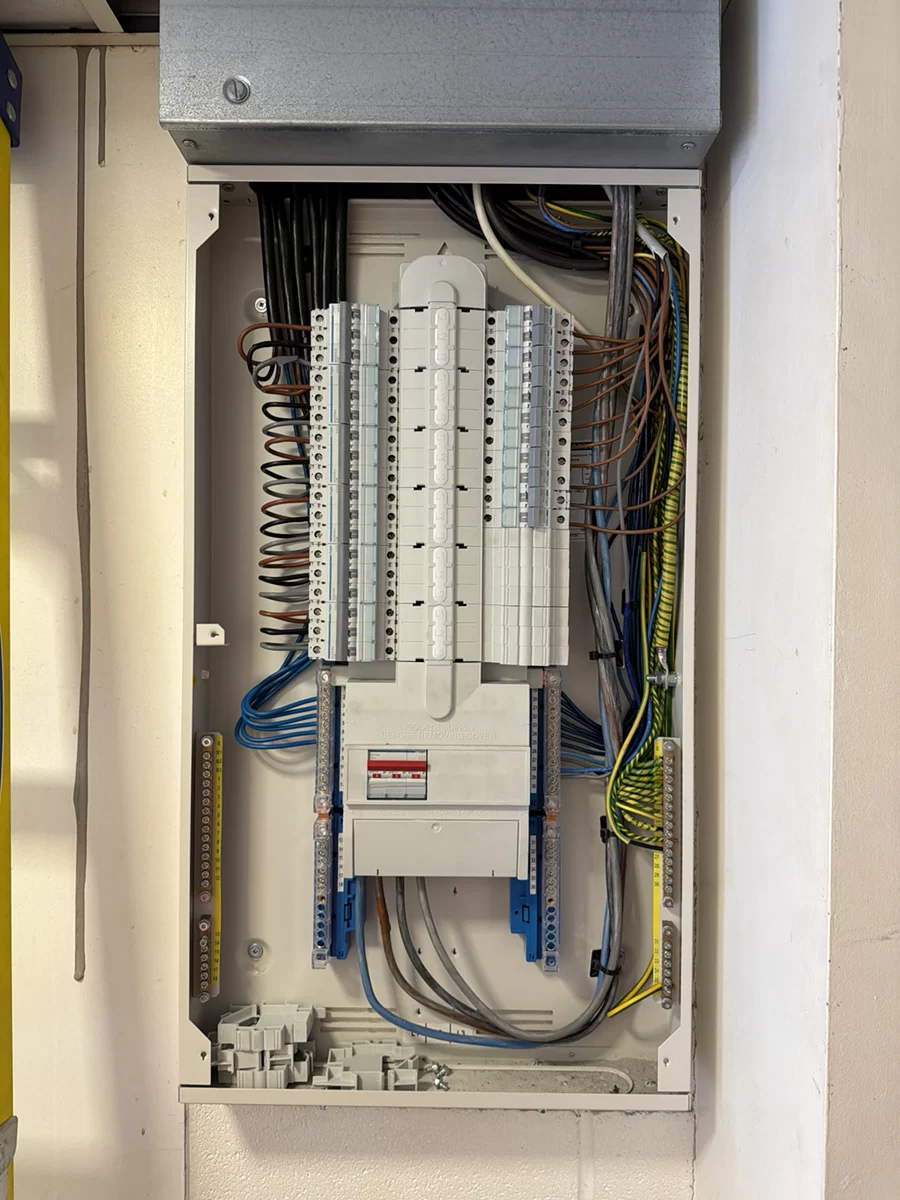
Electrical distribution board thermography is one of the most effective ways to find a developing connection fault before it interrupts a business, and a busy casino cannot afford an unplanned outage. Thermography Services (UK) condition screened eleven distribution boards at a leisure venue in Cardiff, commissioned to support the operator’s insurance position on the fixed wiring. Every board was surveyed energised, with the protective covers removed, under attested operational load.
Fifty thermograms were captured and classified at Level 3, with severity and operational consequence assessed separately. The installation was operating normally throughout, with no safety finding and no measurement approaching the temperature limits applicable to terminations and insulation. Two conditions were identified for further investigation, both at the main kitchen board. The service is survey, analysis and reporting: findings are classified, explained, and referred to suitably qualified specialists.
Why a Casino Commissioned Electrical Thermography on Its Distribution Boards
A casino runs on continuity. Gaming floors, bars, commercial kitchens, ventilation plant and the lighting that keeps a venue open all draw substantial and sustained electrical load, often for eighteen hours a day, and an unplanned interruption is felt immediately in both revenue and reputation. That load profile is also what makes an installation of this kind well suited to thermographic screening. Current flowing through a joint, a termination or a protective device dissipates heat in proportion to the square of the current and the resistance of the path, so a connection that is beginning to loosen or corrode runs measurably hotter than its healthy neighbours long before it fails. Thermography sees that difference while the installation is still working normally, which is precisely when it is most useful to know.
The operator of a Cardiff venue commissioned Thermography Services (UK), a trading name of VisualChaos Studios Ltd, to condition screen eleven distribution boards across the premises, in support of the insurance position on the fixed wiring. Insurers increasingly look for documented evidence that an installation has been assessed by a competent party under a repeatable methodology, rather than an assurance that nothing is wrong. The engagement was survey, analysis and reporting only: every measurement was captured, classified and explained under certified Level 3 thermographic oversight, and anything warranting attention was referred onward to suitably qualified specialists rather than acted upon.
electrical thermography, distribution boards, Cardiff, BS 7671, facilities management, insurance risk, Thermography Services UK, what does electrical thermography detect
How was the electrical thermography survey carried out?
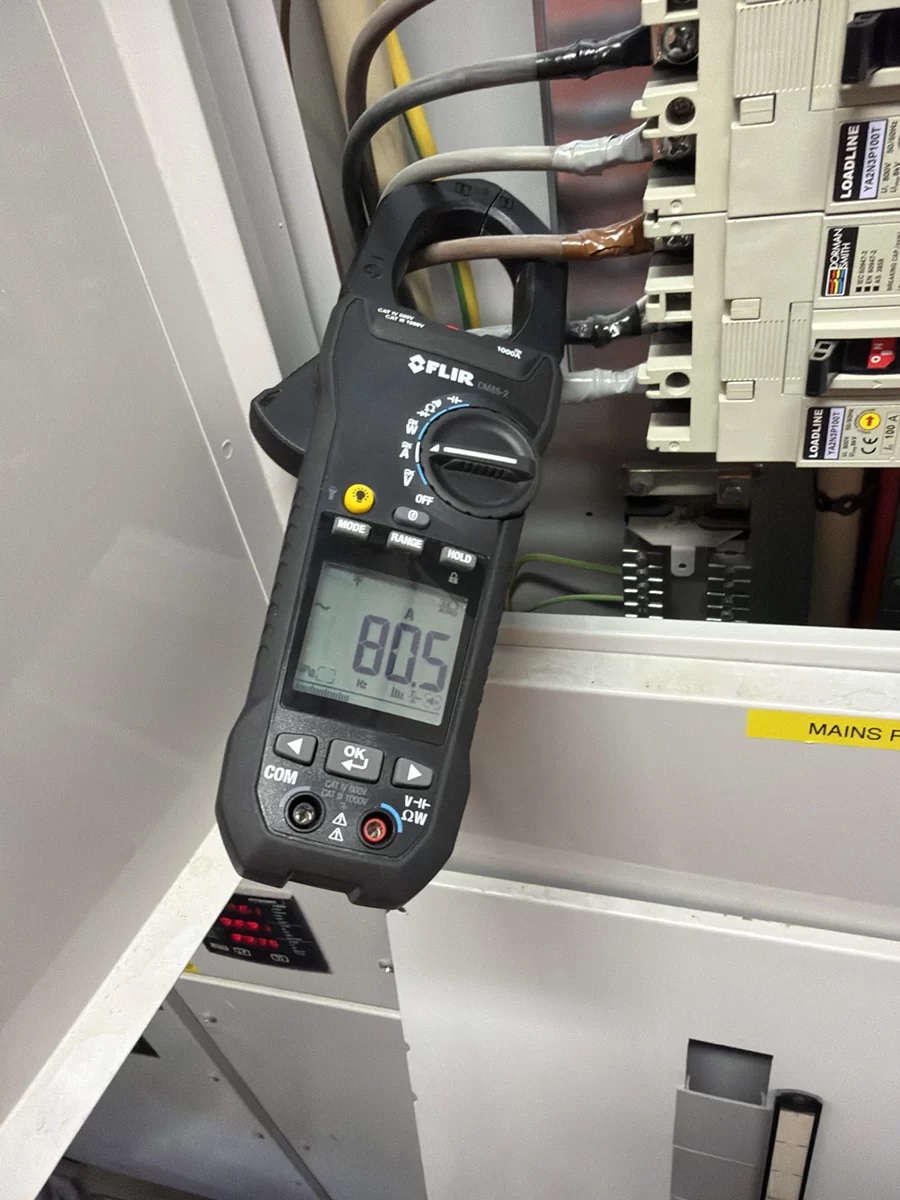
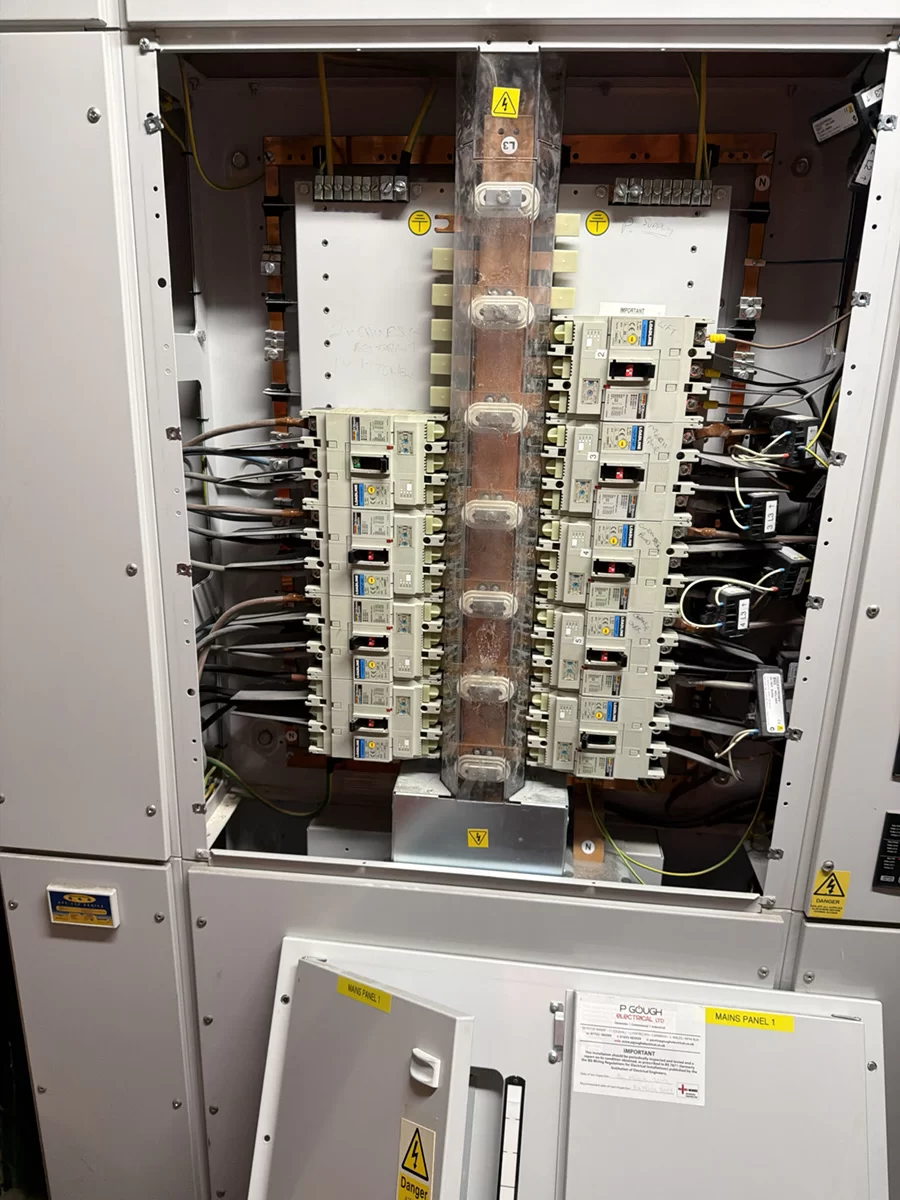
Thermography of an electrical installation is only meaningful under two conditions: the equipment must be energised and carrying representative load, and the internal connections must be visible. Both were arranged in advance. The client’s own contractor removed the protective dead fronts from all eleven boards before the inspection and remained present throughout, attesting the load state at each board, so the internal terminations, busbar connections and outgoing conductors were in view rather than hidden behind a cover. On one board a measured load current was taken at the time of capture, confirming that the panel was genuinely working rather than idling. Two boards, serving a kitchen and a staff kitchenette, could only be surveyed with some equipment out of service. That reduces the sensitivity of the survey on those boards, and the limitation is recorded openly against every image concerned rather than left for the reader to infer.
Environmental conditions were recorded at each board position and the radiometric parameters set per thermogram accordingly, which matters more than it might appear. The premises spanned a public entrance lobby, bars, kitchens and a plant room, and the recorded ambient varied by nearly seven degrees across those positions. Reflected apparent temperature was measured at each board rather than assumed, and a single emissivity value appropriate to the dominant surfaces, painted steel enclosures, moulded device casings and thermoplastic insulated conductors, was applied consistently across the job. Industry-grade thermal imaging and environmental measurement equipment was used throughout, and all data collection on energised equipment ran under the documented safety protocol.
Classification is deliberately not based on absolute temperature. Each measurement is assessed as a temperature difference above a baseline: preferably a comparable device or conductor under similar load within the same image, which cancels the shared measurement error between the two, and where no comparable component exists, the recorded ambient air, with the wider bands that a weaker reference demands. Differences below two degrees are treated as instrument tolerance and normal variation. A measurement becomes a classified anomaly at four degrees above its baseline. Severity and operational consequence are then assessed separately, because a large temperature difference does not automatically mean a serious problem, and a modest one does not automatically mean none.
What did the survey find?
The installation was operating normally at the time of inspection. Across eleven boards and fifty thermograms, nothing carried a safety consequence, and no measurement came close to the temperature limits that apply to terminations and thermoplastic insulation, the highest reading on the site sitting at roughly two thirds of that limit. Most of the heat recorded was exactly what a working installation should produce. Residual current devices ran warmer than plain protective devices, as they always do, because their internal detection circuitry draws current continuously whenever the circuit is energised. Conductors ran warmest where they grouped and bunched and cooled along their separated lengths. Devices stepped evenly across an assembly rather than one standing apart from its neighbours. That distributed, symmetrical pattern is the signature of load, not of a fault, and it is recorded as normal operation with the measurement stated so the reader can see it.
Two conditions did warrant attention, both at the board serving the main kitchen, which unsurprisingly returned the highest device temperatures of any board on site. The first concerned three live conductors leaving that enclosure and passing through the building fabric to a circuit that could not be traced from the accessible aspect. They ran consistently warmer than comparable conductors within the same enclosure, with the warmth continuous along their length and no concentration at any termination, which places the heat in the current being carried rather than in resistance at a joint. Classified Medium severity with an operational continuity consequence, this finding arises from what could not be established rather than from what was measured: the conductor sizing, the installation method and the circuit loading were all unknown, so no assessment against design capacity was offered, and verification was referred onward.
The more significant finding was an ancillary control panel mounted immediately adjacent to that board, a unit that proves the kitchen ventilation is running before gas is supplied. A localised hotspot on its front casing stood more than twenty degrees above the recorded ambient, confined to a discrete area rather than spread across the casing, with visible discolouration of the surface coincident with the thermal signature. The measured value is the outside of a closed assembly, so the component generating the heat inside it is necessarily hotter by a margin that cannot be determined without access. Classified High severity with a degradation trajectory consequence, the recommendation was that the unit be examined rather than simply monitored, and that the manufacturer’s guidance be sought on its continued serviceability.
The Deliverable
The client received a fully referenced PDF report prepared and signed off under certified Level 3 thermographic oversight, suitable to be placed directly in front of an insurer or a maintenance contractor without further interpretation. The report sets out the boards in scope with their access and load states recorded individually, the environmental and radiometric conditions per board position, the severity and consequence framework in full so that any classification can be checked against the method that produced it, and a consolidated findings register giving a single view of every classified observation across the site.
Behind the narrative sits the annex: fifty annotated thermogram pages, each carrying the thermal image, a reference photograph for orientation, the measured values, the baseline used, and a written analysis explaining what the pattern indicates and why. Nothing is asserted without the measurement that supports it, and every limitation, whether a board surveyed under reduced load or an enclosure where only part of the interior could be reached, is stated on the page it affects. Where a measurement sat close to a classification boundary, the higher band was taken.
The recommendations go no further than they should. Thermography identifies and classifies thermal behaviour; it does not test, it does not diagnose an electrical fault to component level, and it does not repair. The two conditions identified were referred to a suitably qualified and competent person for investigation, with the reasoning laid out so that whoever picks the work up understands what was seen and what was not. The survey also stands as a baseline thermal record of the installation, which is arguably its longer-term value: a future inspection compared against it will show whether any condition is progressing, and a stable comparison is itself evidence worth holding.
Thermography Services (UK), a trading name of VisualChaos Studios Ltd, delivers electrical, building and solar thermography at Level 3 across the UK, Ireland and Europe, with thermographic consultancy worldwide, and provides an independent Level 3 analysis and reporting service where a third-party operator has captured the data. If you are being asked for thermographic evidence on your fixed wiring, or you would simply like to know the condition of your distribution equipment before it tells you itself, we would be glad to discuss it.
Does your insurer want thermographic evidence on your fixed wiring?
Thermography Services (UK), a trading name of VisualChaos Studios Ltd, carries out electrical distribution board condition screening at Level 3, producing a defensible classified record your insurer, your board and your contractor can all work from. We cover the UK, Ireland and Europe, with thermographic consultancy worldwide. Tell us what you have and what you are being asked for, and we will tell you plainly what a survey would and would not establish.


