
Specialist Water Detection Using Thermal Imaging In Canary Islands
Phase 1 aerial thermography investigation into underground water leak detection carried out in Lanzarote using drone-mounted radiometric thermal imaging and Level 3 thermographic analysis methodologies. Thermography Services (UK) developed a structured proof-of-concept survey process to evaluate whether buried water infrastructure anomalies could be identified through comparative surface thermal behaviour within a volcanic urban environment. The project focused on controlled dawn data capture, multi-altitude thermal imaging, RGB correlation, and disciplined environmental interpretation to reduce false-positive indications caused by solar loading, paving materials, and subsurface construction features. High-resolution thermal datasets were analysed to identify patterns potentially associated with moisture migration, evaporative cooling, and disturbed ground conditions above buried pipework.
The study also examined the operational limitations of aerial thermography in underground leak investigations, highlighting the importance of environmental timing, spatial resolution, and contextual engineering understanding. This project demonstrates how drone thermography can support non-invasive underground water leak detection, infrastructure diagnostics, utility asset management, and preventative maintenance planning when applied within a controlled, evidence-led survey framework.
aerial thermography, water leak detection, underground pipeline survey, Lanzarote, Canary Islands, Level 3 thermographer, ISO 18436-7, how to detect underground water leaks without excavation
Underground Water Leak Detection Using Aerial Thermography, Lanzarote, Part One
Municipal water networks lose significant volumes of water to undetected underground pipe leaks every year. Aerial thermography offers a non-invasive first-pass screening layer capable of covering extended pipeline corridors in a single pre-dawn survey, but when the target pipe runs in the same buried trench as a second, thermally dominant pipe, the standard single-baseline approach cannot resolve the signal it is looking for. The methodology has to change.
Thermography Services (UK) was engaged by Skynox drones as Level 3 thermographic analysis and reporting consultant for a 517 m test segment of a municipal water distribution network in Lanzarote, Canary Islands. A specialist local aerial survey operator captured the pre-dawn radiometric data. Everything from analytical framework design through to the certified findings report was carried out under Level 3 Master Thermographer supervision, following the Survey, Discussion, Workflow and Planning, Analysis, Findings and Reporting process from first principles. The pages below record what was developed, what was found, and what the findings enable.
The Project and Its Setting
Thermography Services (UK) was commissioned by Skynox Drones in a Level 3 thermographic analysis and reporting consultancy role by a specialist aerial data services provider operating in Lanzarote, working on behalf of a Canary Islands municipal water authority. The water authority’s objective was to evaluate whether thermographic screening could identify subsurface leak-related thermal behaviour across a 517 m test segment of the distribution network, with a view to informing a potential wider programme covering a significantly larger corridor. Thermography Services (UK) carried no operational role in the survey flight. The engagement covered analytical framework design, the full thermographic assessment, candidate classification, and the production of a certified Level 3 report.
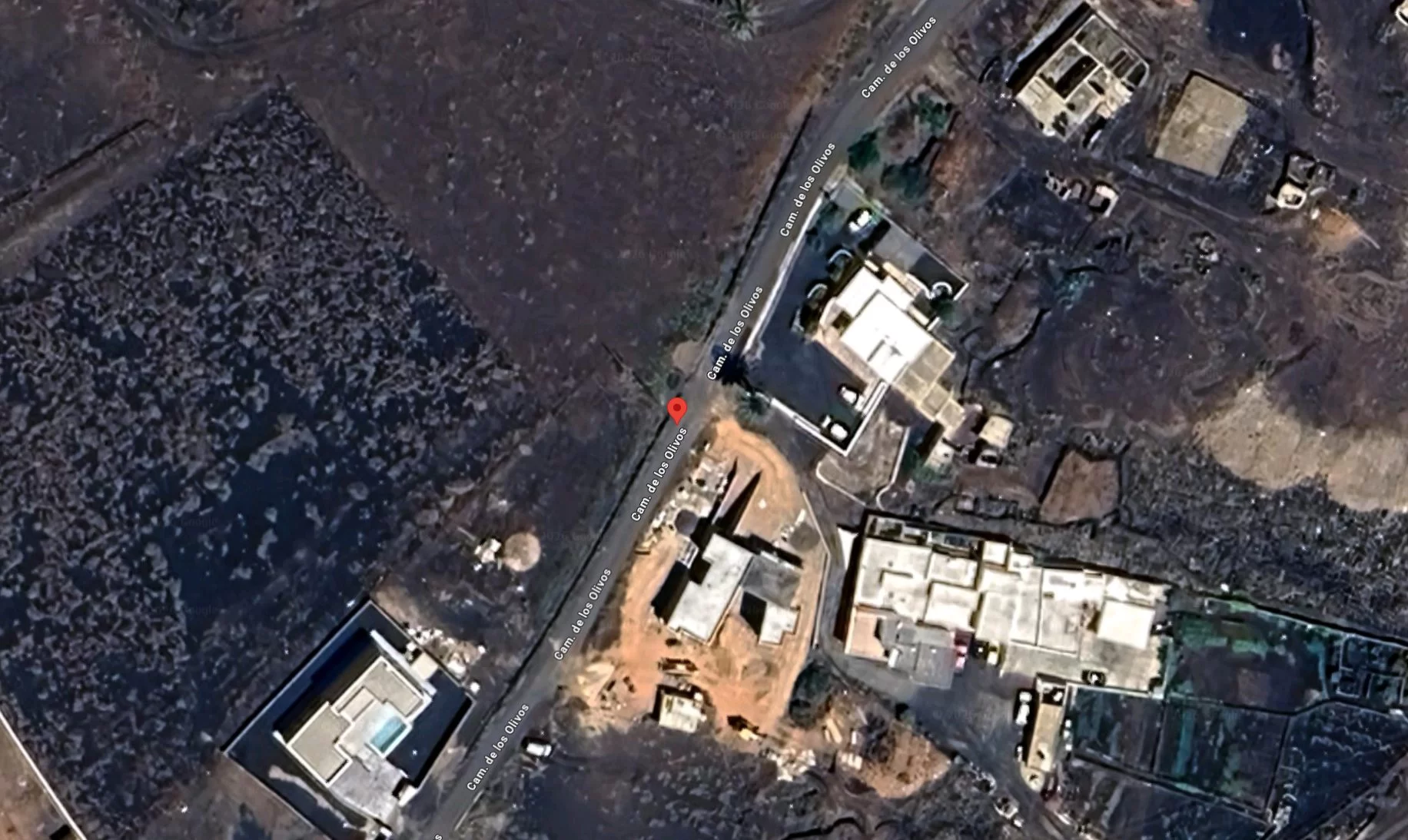
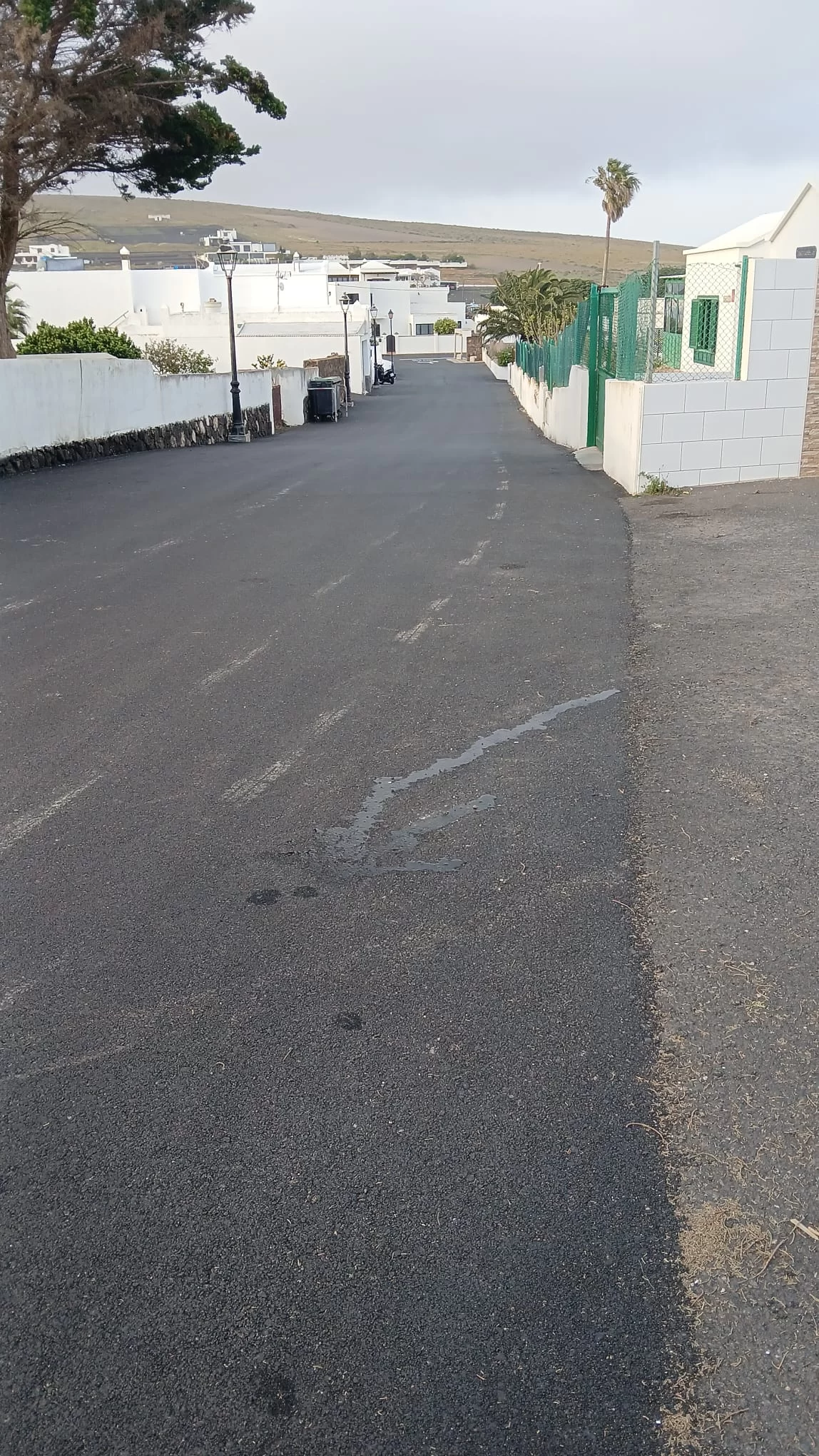
The survey corridor runs along a residential road in Tías, Lanzarote, passing through a section of the municipal water distribution network. The corridor is paved throughout, with roadside vegetation present in the central and northern sections and a history of surface reinstatement patches consistent with prior maintenance works. At survey time it was understood that the potable water main ran within the same buried trench as a sewer for the full corridor length. This shared-trench arrangement was the defining analytical constraint of the project: the sewer produced a persistent warm thermal signature at the road surface, typically one to three degrees above ambient, masking the very corridor in which a potable water leak signal would need to be identified.
Aerial data was captured pre-dawn on 27 March 2026, commencing at 06:44 local time. Ambient air temperature was 14.3 degrees, road surface temperature 14.6 degrees, relative humidity 80 percent, and cloud cover approximately 50 percent increasing toward drizzle at sunrise. The survey platform operated at 30 m above ground level, achieving approximately 3 cm ground sample distance. Pre-dawn timing was selected because at this point in the diurnal cycle dry road surfaces approach near-equilibrium with ambient air temperature, solar loading artefacts are absent, and the contrast between moisture-affected and dry sub-base material is at its greatest.
How Was the Thermographic Analysis Approach Developed for This Environment?
Standard thermographic leak detection applies a single isotherm threshold above the ambient road surface temperature and looks for anything that breaks it. In a single-pipe corridor, this is challenging but tractable. In this corridor, the sewer produced a continuous warm band the full length of the route, and applying a road-surface threshold simply illuminated that entire band as one undifferentiated warm zone. The analytical question had to change from “is this warmer than the road?” to “is this warmer than a normal section of this specific pipe?” Resolving that smaller departure required a reference system built around the pipe rather than the road surface.
Our Level 3 Master Thermographer designed a dual-baseline reference system. El1, an ambient road surface reference, was established on clean east-side asphalt clear of all pipe influence and set empirically per frame. El2, a local pipe temperature baseline, was established on a stable and uniform section of the dominant pipe signature in each corridor zone, set per zone rather than across the full corridor to account for the expected north-to-south variation in pipe temperature as hydraulic load changed along the route. The analytical threshold for the pipe corridor was El2 plus 0.3 degrees as the entry level for review, rising to El2 plus 0.5 degrees for Confirmed Candidate classification.
The scope of the analysis covered 42 thermograms selected from approximately 125 captured frames, together with co-registered RGB imagery for each frame. Scope included the paved road corridor from the northern pumping station boundary to the southern limit of the survey segment, all access covers and surface features identified in the RGB imagery, and all pipe corridor frames where isotherm breakthrough was observed. Open land, vegetation and non-paved surfaces were assessed but treated as generally non-diagnostic, consistent with established practice for thermographic leak assessment in
What Did the Two-Pass Classification Identify Across 42 Thermograms?
The First Pass applied an isotherm at El2 plus 0.3 degrees across all pipe corridor frames. Any feature breaking the isotherm in or adjacent to the pipe corridor was flagged for Second Pass review. Frames with no breakthrough, or with breakthrough confined to confirmed infrastructure features such as access covers, were classified as Released at First Pass with a documented rationale. Of the 42 thermograms reviewed, a significant proportion were Released at this stage based on clear documented evidence.
The Second Pass applied a seven-criteria evidence assessment to every flagged candidate in order: temperature magnitude above El2 using a spot measurement on the anomaly peak; geometry assessment using a line profile perpendicular to the pipe axis; profile shape along the pipe axis to distinguish a localised departure from a general section elevation; isotherm width to assess lateral broadening beyond the normal pipe corridor footprint; directional asymmetry for south-westerly elongation consistent with moisture migration following the corridor gradient; RGB cross-reference for surface condition at the anomaly location; and infrastructure proximity. A within-dataset calibration finding confirmed that fresh road reinstatement patches in this corridor read marginally cooler than surrounding aged asphalt, eliminating patch material as a thermal source and requiring a subsurface explanation wherever warmth appeared over pipe corridor patches.
Six thermogram locations across four geographic clusters met the full evidence criteria for Confirmed Candidate classification. Each is supported by three or more independent Second Pass criteria converging without a satisfactory surface or infrastructure explanation. The highest single departure recorded in the dataset was plus 1.3 degrees above El2, at the northern corridor end on clean unmodified asphalt with no known infrastructure fitting at that position. Two of the four clusters were supported by two consecutive thermograms at the same approximate location, where the same anomaly character was independently recorded in adjacent frames.
| Cluster | Corridor Section | Frames | Peak Delta-T above El2 | RGB Surface |
|---|---|---|---|---|
| A | Southern | 2 | +0.7 degrees | Clean asphalt |
| B | Mid-southern | 1 | +0.6 degrees | Clean asphalt |
| C | Transitional | 2 | +1.0 degrees | Clean asphalt |
| D | Northern | 1 | +1.3 degrees | Clean asphalt |
A further 22 thermogram locations in the central and northern corridor were classified as Possible Candidate. Temperature thresholds were met in several cases, but roadside vegetation visible in the RGB imagery provided a competing explanation through natural root-zone moisture retention, which operates through an identical thermal mechanism to subsurface pipe leakage. Thermography cannot separate these two sources when they are spatially coincident. These locations are not cleared. They are a priority zone for ground-based acoustic or pressure investigation.
What Made This Pipeline Survey Analytically Distinctive?
The dual-baseline reference system, and the specific thresholds designed for a compressed-contrast detection environment, represent a methodological contribution that goes beyond standard single-reference thermographic practice. The El2 local pipe baseline concept, established per corridor zone to account for the hydraulic temperature gradient, requires an understanding of pipe system thermal behaviour at the road surface, not simply the application of an isotherm to a dataset. The within-dataset patch calibration observation, which emerged during the Second Pass analysis rather than being designed in advance, is an example of the contextual reasoning that structured Level 3 interpretation is built to produce: a defensible, evidence-led argument that eliminates an alternative explanation without requiring external reference data.
The decision to classify the northern vegetation zone as Possible Candidate rather than Released reflects the professional discipline the project required. Several frames in that zone recorded departures exceeding those of confirmed candidates elsewhere in the corridor. Releasing those locations because the alternative explanation was convenient would have been analytically indefensible. This is Part One of the project record. Part Two will follow on publication of Report V2.0, covering a material change in infrastructure understanding that emerged after Report V1.0 was delivered and the revised analysis that results. The methodology documented here remains the analytical foundation for that revised work.
Does Your Infrastructure Network Need Thermographic Screening?
Thermography Services (UK) provides certified Level 3 thermographic analysis, interpretation and reporting for complex infrastructure applications across the UK, Europe and internationally. Every engagement is conducted under ITC Level III Certified Master Thermographer (Infrared Training Centre; Certification #205722059), practising in accordance with the frameworks of ISO 18436-7:2014, ASNT SNT-TC-1A and ANSI/ASNT CP-105, and BINDT CMGEN Appendix B as UK training governance, with methodology aligned to IEC 62446-3:2017 and EN 13187:1999 as applicable., and delivered as a professionally structured, defensible certified report. Get in touch to discuss your requirements. Initial consultations are free and without obligation.


