
When a homeowner began noticing heating bills significantly higher than the projections provided at the time of purchase, a visual inspection of their new-build property offered no clear explanation. The walls looked right. The insulation had been signed off. Everything appeared in order. What was needed was a survey capable of seeing what the eye cannot, and what a building regulations sign-off does not necessarily verify.
Thermography Services (UK) was commissioned to conduct a full building envelope thermographic inspection, covering both internal and external faces, under Level 3 Master Thermographer certification and aligned to BS EN ISO 6781-1:2023. What it found was both systematic and instructive.
A combined internal and external building envelope thermographic inspection was commissioned for a new-build residential property in the Chilterns to investigate thermal performance concerns. Conducted to BS EN ISO 6781-1:2023 under Level 3 Master Thermographer certification, the survey identified widespread insulation deficiency across the first-floor ceiling void, continuous ground-floor perimeter thermal bridging, confirmed air infiltration at two locations, and sustained external wall surface heat loss across multiple elevations. Findings were compiled into a professionally structured, defensible report.
Uncovering the Hidden Thermal Performance of a New Build: A Full Envelope Infrared Investigation
When a homeowner began noticing heating bills significantly higher than the projections provided at the time of purchase, a visual inspection of their new-build property offered no clear explanation. The walls looked right. The insulation had been signed off. Everything appeared in order. What was needed was a survey capable of seeing what the eye cannot, and what a building regulations sign-off does not necessarily verify.
Thermography Services (UK) was commissioned to conduct a full building envelope thermographic inspection, covering both internal and external faces, under Level 3 Master Thermographer certification and aligned to BS EN ISO 6781-1:2023. What it found was both systematic and instructive.
building thermography, new build survey, thermal bridging, insulation deficiency, air infiltration, BS EN ISO 6781-1, Level 3 thermographer, Heat Loss
Why This Survey Was Commissioned
A homeowner commissioned Thermography Services (UK) to investigate the thermal performance of their new-build residential property, completed approximately one year prior to the survey date. The property is a detached residential dwelling of traditional cavity construction with a mixed ground and first floor layout, incorporating wet underfloor heating on both floors served by a gas boiler. Measured gas consumption since occupation had departed significantly from the projections provided at the time of purchase, prompting a structured investigation into the thermal integrity of the building fabric.
The scope of the survey was agreed as a building envelope inspection covering all accessible internal rooms and the complete external perimeter. Thermography Services (UK) carried out the work in its capacity as a specialist thermography practice, with all survey design, data capture, and Level 3 analysis completed by a Certified Master Thermographer. The findings were intended to contribute to a professionally structured body of evidence suitable for independent review.
Survey conditions were arranged to maximise thermographic sensitivity. The property heating system was operated continuously for a minimum of 24 hours prior to the survey, establishing a stable thermal load across the envelope. The survey was conducted in April, beginning at 18:00, allowing ambient temperatures to fall sufficiently to create the temperature differential required by BS EN ISO 6781-1:2023 for meaningful qualitative analysis. External sky conditions were clear, which introduced additional radiometric considerations for the external phase of the survey, discussed under methodology below.
The property’s construction, whilst recent, incorporated several features presenting thermographic complexity: a three-storey staircase void connecting ground and upper floors, multiple ceiling configurations including flat and pitched elements, a mix of externally exposed and party-wall configurations, and a south-facing terrace with a parapet wall. These features were assessed within the full survey scope and are reflected in the findings.
Survey Scope and Objectives
This survey was commissioned as a full building envelope investigation, with scope defined to cover all accessible internal rooms and spaces on both floors, plus the complete external perimeter of the property at ground and first-floor level. The objective was to assess the thermal integrity of the building fabric, with specific focus on insulation continuity, structural thermal bridging, air infiltration pathways, and external heat loss. The Survey, Analysis, and Reporting methodology employed by Thermography Services (UK) governed the project from environmental assessment and data capture through to classified thermogram annotation, findings interpretation, and the delivery of a structured professional report.
Internal survey coverage included all principal ground-floor rooms, the staircase and circulation space, all first-floor rooms and the hall, the first-floor ceiling voids where accessible by thermographic observation from below, and miscellaneous building fabric elements including the chimney breast and flue zone. External coverage included all principal elevations, the parapet wall to the terrace, and eaves and window surrounds at all accessible faces. No roof-level access was available or required for this survey type; external roof-level thermography was not within scope.
The Problem: What Were We Looking For?
The client’s primary concern was energy performance, specifically why metered consumption was substantially higher than projected. Thermography was identified as the appropriate investigative tool because the building fabric elements most likely to account for that departure, namely insulation discontinuity, thermal bridging, and air infiltration, are not detectable by visual inspection once a building is complete and decorated. They are, however, directly detectable by calibrated infrared imaging when the correct thermal load and environmental conditions are established.
The physics underpinning this is straightforward. Where insulation is absent, disrupted, or significantly compressed, the thermal resistance of the affected zone is reduced. Under a sustained heating load, the interior surface above that zone will appear warmer than the surrounding insulated area, because heat is conducting more readily through the reduced resistance path to the external face. Conversely, a structural element with a higher thermal conductivity than the surrounding insulated fabric — a cold bridge — will present as a cooler interior surface, because the element is conducting heat away from the internal face faster than the insulated zones around it. Air infiltration produces a characteristically different thermal signature: cooling of the internal surface at the infiltration point, consistent with cold external air entering through a gap or junction failure.
All three mechanisms were within the scope of this survey. The ability of infrared thermography to reveal them simultaneously, non-invasively, and across the full building envelope in a single survey was the principal reason it was the method of choice.
Survey Methodology and On-Site Deployment
Environmental Conditions
The survey was conducted in April. Ambient external temperature at survey commencement was recorded, and the temperature differential between the internal heating set-point and the external ambient was sufficient to meet the minimum delta-T requirement for qualitative building thermography as specified under BS EN ISO 6781-1:2023. The heating system had been operating continuously for a minimum of 24 hours prior to survey commencement, ensuring a stable and uniform thermal load was present across the building fabric.
External conditions during the survey phase were clear sky with low wind. Whilst this is operationally favourable for access and visibility, a clear sky presents a radiometric challenge for external building thermography that requires careful management. A clear night sky presents a very cold apparent radiant temperature, in this survey, measured zenith sky temperature was approximately -38.6°C. Because a vertical wall surface has a view factor of approximately 50% to the sky hemisphere and 50% to the ground plane, and the ground plane contributes a reflected temperature close to ambient, the correct reflected apparent temperature (TRefl) for vertical external surfaces is not the zenith sky temperature, but a weighted composite of the two. The corrected TRefl applied across all external vertical surfaces in this survey was -10.6°C, calculated from the view factor-weighted composite of the sky zenith temperature and the ambient ground-plane temperature. For any upward-facing horizontal surfaces, the full zenith sky TRefl was applied separately.
Equipment and Data Capture Approach
The internal survey was conducted using a high-resolution radiometric thermal imaging camera operating in the long-wave infrared spectrum, configured with emissivity set to 0.95 consistent with painted and plastered internal wall, ceiling, and floor surfaces. The external phase of the survey employed a second high-resolution radiometric thermal imaging system with equivalent spectral characteristics, set up with the corrected TRefl value for each surface type. All instruments were allowed to reach thermal equilibrium prior to data capture. Distance-to-target was managed throughout to ensure spatial resolution was sufficient to resolve the anomaly types being investigated. Both instruments operated as calibrated radiometric systems; no non-calibrated or non-radiometric thermal devices were used at any stage.
Survey Execution
The internal survey followed a systematic room-by-room approach, with each space recorded in a consistent sequence covering floor-to-wall junctions, wall-to-ceiling junctions, window and door surrounds, external wall faces, and any penetrations or service entries. Wall and ceiling surfaces were examined at close to normal incidence where possible to minimise reflected apparent temperature contribution from room furnishings and fittings. All thermograms were captured as radiometric files, preserving full temperature data at every pixel for post-survey analysis. Visible-light reference images were captured alongside each thermogram to support co-registration and reporting.
The external survey proceeded anti-clockwise around the building perimeter, covering all accessible elevations in sequence. Each elevation was covered in overlapping passes to ensure complete coverage without gaps. At locations presenting visual evidence of potential moisture pathways, including areas of efflorescence and two-tone brickwork discolouration, additional thermograms were captured at multiple times within the survey window to assess for any thermal signature consistent with evaporative cooling, which would indicate active or residual moisture at the surface. No such signature was detected at any of those locations under the survey conditions.
Key Observations and Findings
Findings and Thermal Analysis
The survey produced a substantial and consistent body of evidence across both the internal and external phases. Findings fell into four principal categories: insulation deficiency, structural thermal bridging, air infiltration, and external heat loss. In each case, findings were assessed individually and as a cumulative body of evidence, recognising that the interaction between multiple concurrent anomaly types contributes to overall building envelope performance in a way that exceeds the sum of the individual items.
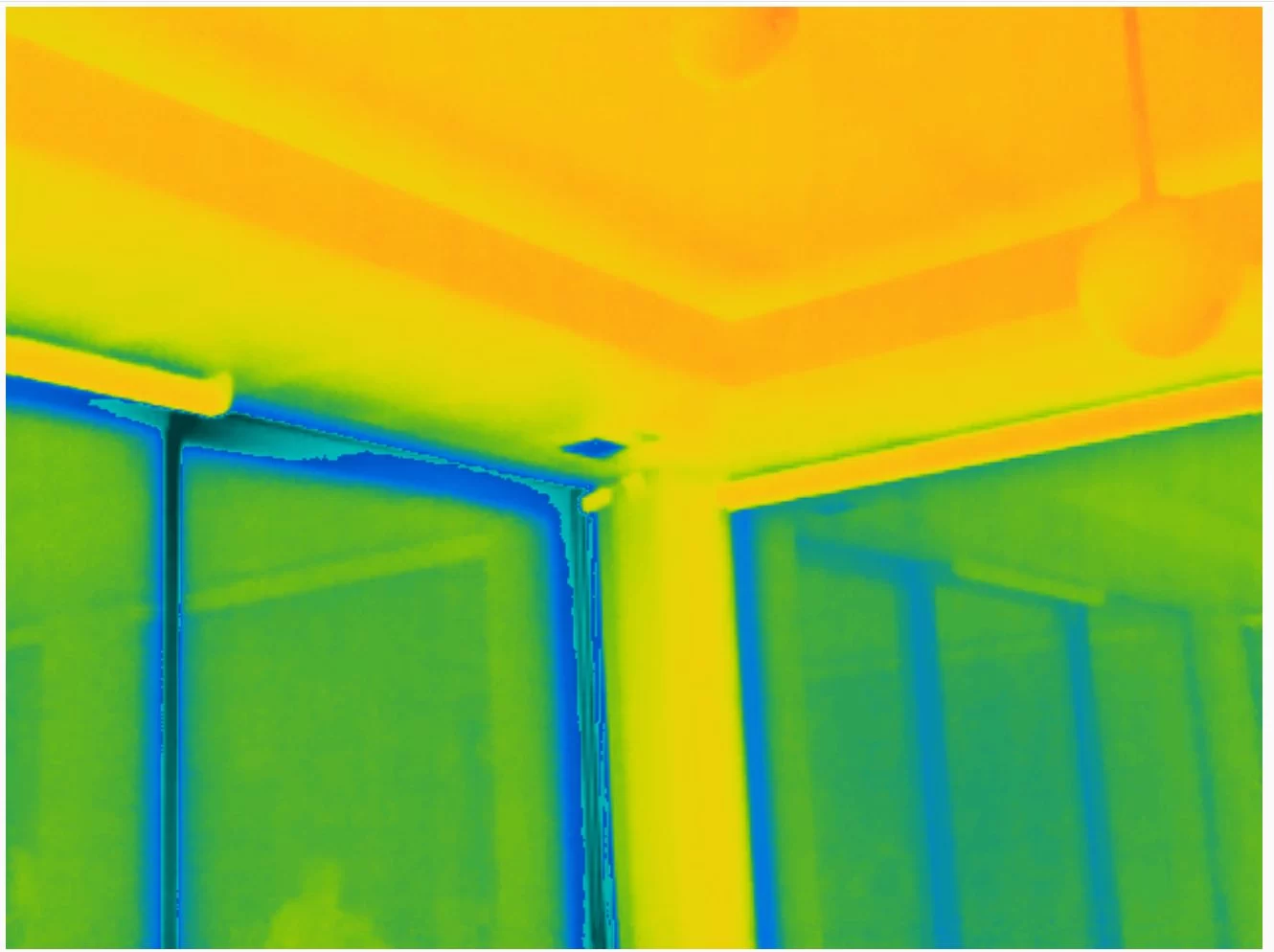
Insulation deficiency was identified across the first-floor ceiling voids in multiple rooms, including the principal bedroom, secondary bedrooms, the first-floor hall, toilet, and shower room. The thermal signature in each case was consistent with either absent or significantly disrupted insulation above the ceiling plane, presenting as warm ceiling surface patches where heat from the conditioned space below was conducting directly into the void above without adequate resistance. The pattern was not confined to a single zone or a single room, suggesting a systemic installation issue rather than an isolated gap.
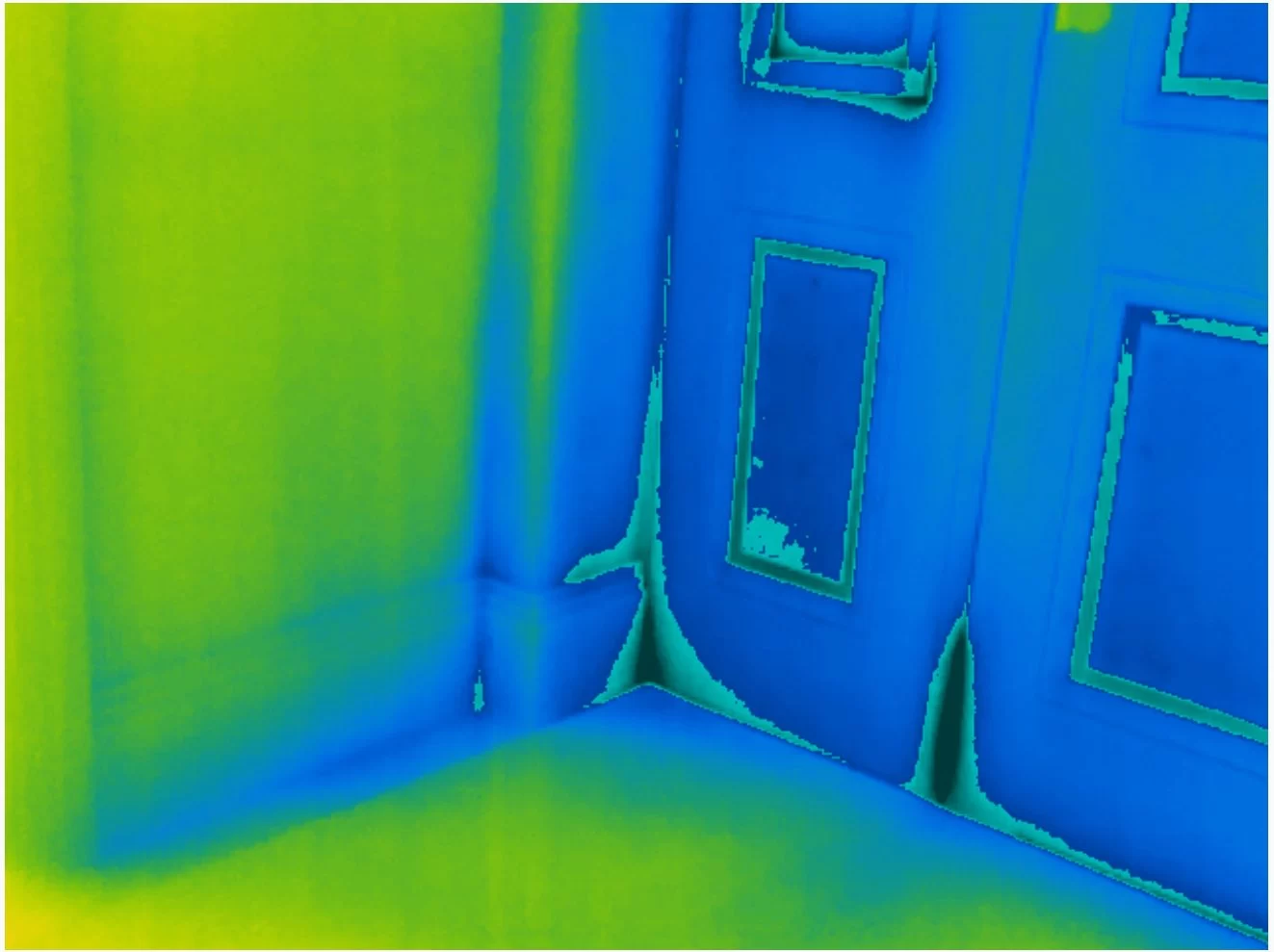
Structural thermal bridging at the ground-floor perimeter was one of the most consistent findings across the survey. A continuous cooler zone was observed at the internal floor-to-wall junction throughout the ground floor, consistent with a cold floor slab edge or absent or inadequate perimeter insulation at the slab. Additional thermal bridging was identified at external wall corners, window surrounds, and the external frame of skylights at first-floor ceiling level.
Air infiltration was confirmed at two locations. The front door frame presented a thermal signature consistent with cold air infiltration at the junction between the frame and the surrounding structure. The chimney flue penetration through the building envelope presented a similar pattern, consistent with cold air ingress around the flue casing at the point where it passes through the thermal envelope.
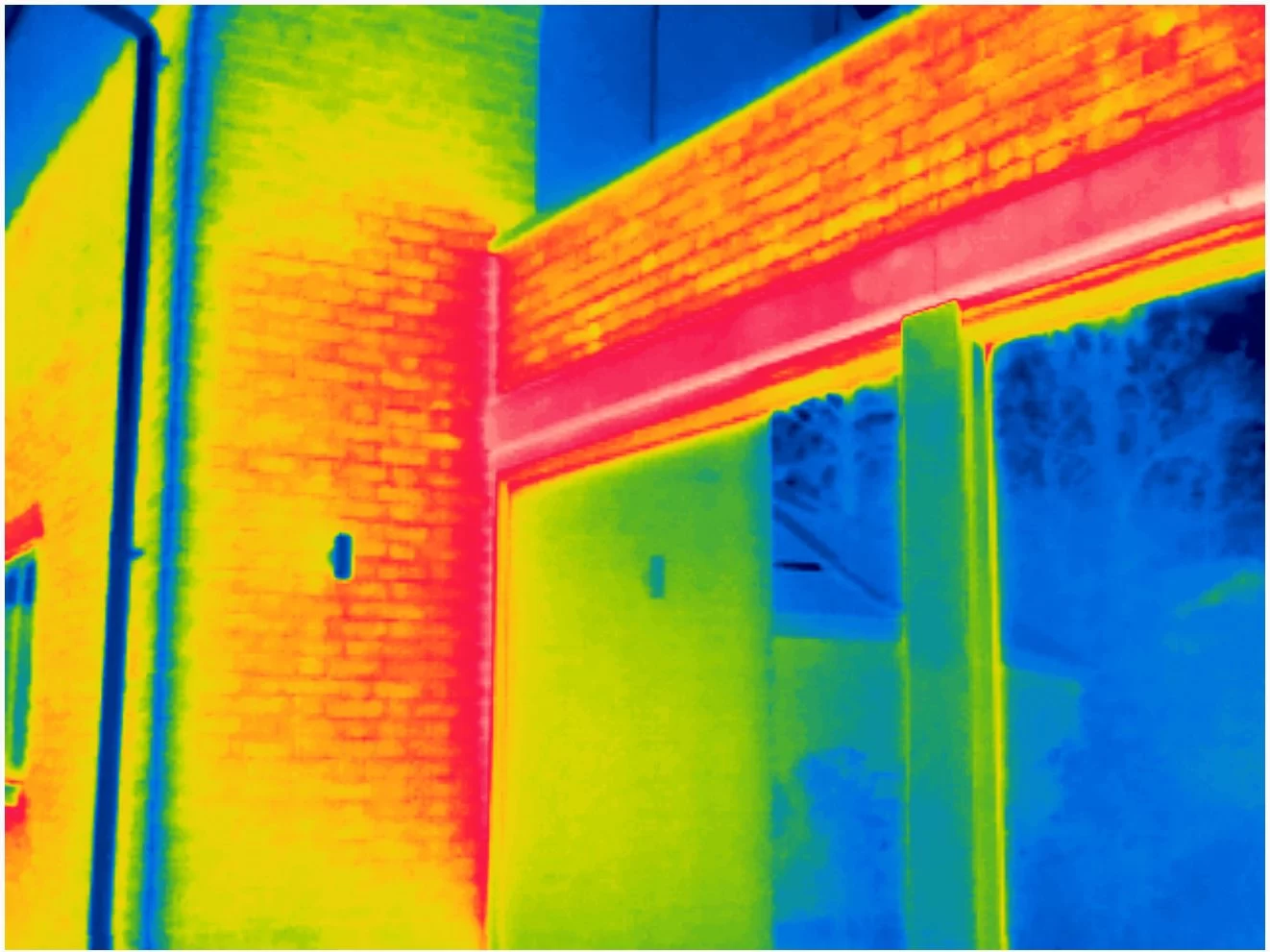
External heat loss was confirmed across multiple elevations, with elevated surface temperatures on the external wall faces consistent with sustained heat loss from the interior through the wall construction. The north elevation and the staircase zone were particularly notable. The staircase, connecting ground and upper floors without intermediate thermal breaks, creates a convective column that drives warm air upward and increases the temperature of the external wall surface at that location above the baseline expected for a well-insulated cavity wall.
Outcome & Interpretation
What Made This Survey Stand Out
Several factors combined to make this a technically demanding and professionally distinctive project.
The first is context. This survey was not a pre-purchase inspection or a routine maintenance check. It was commissioned for a property where the homeowner had substantive concerns about thermal performance, supported by metered energy data that departed significantly from developer projections. The thermographic survey was required to contribute to a body of evidence capable of withstanding independent professional scrutiny. That places a materially different demand on the thermographer compared to a standard condition inspection: every finding must be clearly qualified, every threshold rigorously applied, and every piece of language professionally defensible. At Level 3, that is the standard Thermography Services (UK) holds itself to on every project. On this one, it was explicitly the brief.
The second distinguishing factor is the radiometric rigour applied to the external survey phase. External building thermography under clear sky conditions requires careful management of the reflected apparent temperature correction. A clear night sky presents a very cold apparent radiant temperature at zenith, and the contribution of that sky radiance to the apparent temperature of a vertical wall surface is material. A simplified or default reflected temperature value would introduce systematic errors into every external measurement. The corrected TRefl value of -10.6°C applied to all vertical surfaces in this survey was derived from a view factor calculation accounting for the approximately equal contribution of the sky hemisphere and the ground plane to a vertical wall surface, with the measured zenith sky temperature applied separately to upward-facing horizontal surfaces. This level of radiometric rigour is not universally applied in building thermography practice. It is the correct approach, and it is the approach consistent with professional Level 3 standards.
The third element is the integration of the internal and external survey into a single coherent evidence set. The internal survey identifies the nature, location, and character of thermal anomalies at the interior surface. The external survey independently corroborates or contextualises those findings from the exterior. Where both perspectives converge on the same location, the finding is strengthened. Where the external phase shows elevated surface temperatures consistent with heat loss at a location where the internal phase has identified insulation deficiency or thermal bridging, the two data sets are mutually reinforcing. That level of evidence integration is only achievable with a dual-phase survey, and it is what separates a comprehensive building thermography report from a single-pass scan.