
Level 3 Thermography Analysis for BREEAM Compliance, London
A building performance consultancy in London commissioned Thermography Services (UK) to provide Level 3 thermographic analysis and certified reporting for a BREEAM new construction assessment at a large multi-storey student accommodation development. The consultancy’s Level 1 thermographer had captured 28 thermograms across the building’s external envelope and internal spaces under pre-dawn conditions with a working delta-T of approximately 11 degrees Celsius, meeting the threshold required by EN 13187.
Our Level 3 Master Thermographer reviewed the complete dataset, corrected classification and severity entries where required, confirmed a glazing head fault condition using comparative unit analysis, and produced a certified deliverable ready for BREEAM submission.
A building performance consultancy in London commissioned Thermography Services (UK) to provide Level 3 thermographic analysis and certified reporting for a BREEAM new construction assessment at a large multi-storey student accommodation development. The consultancy’s Level 1 thermographer had captured 28 thermograms across the building’s external envelope and internal spaces under pre-dawn conditions with a working delta-T of approximately 11 degrees Celsius, meeting the threshold required by EN 13187.
Level 3 thermography analysis, BREEAM compliance, building thermography, student accommodation, thermal bridging, London, Thermography Services UK, who provides Level 3 thermography analysis for Level 1 thermographers
Standards and Governance
- EN 13187 specifies the thermographic method for detecting thermal irregularities in building envelopes, covering survey conditions, interpretation methodology and reporting requirements for building envelope assessment.
- ISO 6781-3 covers the detection of heat, air and moisture irregularities in buildings by infrared methods, providing the analytical framework for thermographic assessment of building fabric.
- ISO 18436-7 defines the training and certification requirements for thermographic condition monitoring personnel, establishing the competence framework under which Level 3 thermographic analysis is carried out.
- ISO 18436-1 sets the general requirements for training and certification of condition monitoring and diagnostics personnel, underpinning the certification hierarchy applied to this engagement.
- ISO 9712 sets the general framework for the qualification and certification of non-destructive testing personnel, within which thermographic competence is formally recognised.
Level 3 Thermography Analysis for a New-Build Student Development
What does Level 3 thermographic analysis add to a Level 1 survey?
This commission is a standing engagement. A specialist building performance consultancy provides BREEAM assessments for new-build developments and employs a qualified Level 1 thermographer to carry out on-site data capture and first-pass dataset annotation. Thermography Services (UK) provides the Level 3 analysis, correction, and certified reporting layer under a services agreement. This model allows the consultancy to offer its clients a fully standards-referenced thermographic survey and certified deliverable without holding Level 3 thermographic competence in-house, a practical and commercially efficient arrangement that is increasingly common in the building compliance sector.
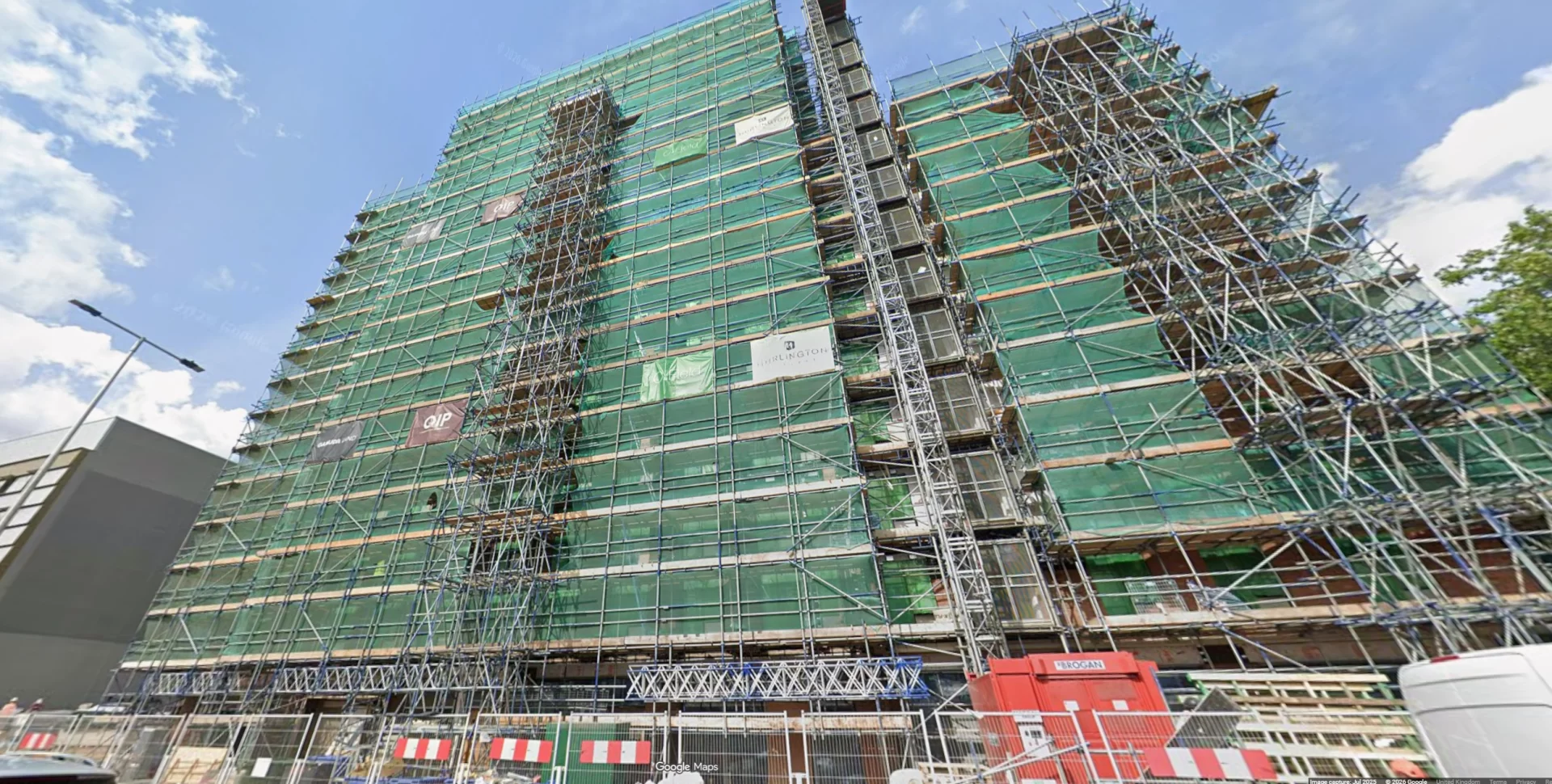
The survey was conducted at a newly completed multi-storey student accommodation development in London. The building comprises over a dozen floors of student rooms, studios, communal kitchen areas and amenity spaces. The external envelope combines brick rainscreen over a steel frame system on the lower and mid floors with a standing seam metal rainscreen at the upper set-back level, a two-zone construction that carries different thermal performance characteristics and different emissivity considerations for thermographic assessment. The survey was completed under pre-dawn conditions before solar loading could influence surface temperatures, with a working temperature differential of approximately 11 degrees Celsius, conformant with EN 13187.
The Level 1 thermographer submitted 28 thermograms alongside a first-pass FLIR Studio annotation report. The dataset covered external facade captures on two elevations, internal student rooms, studio rooms, cluster kitchen areas, corridor end windows at multiple floors, terrace access junctions and ground floor amenity spaces. The dataset presented several quality challenges, including parameter entry inconsistencies and an elevated internal baseline pattern attributable to the thermal influence of electric panel heaters in adjacent rooms. Thermography Services (UK) addressed each of these within the Level 3 analysis, qualifying classification where absolute differential calculation was not valid and applying relative within-thermogram assessment throughout the affected internal captures. All 28 thermograms were reviewed and carried forward to the certified deliverable regardless of diagnostic weight.
How does Level 3 thermographic analysis work alongside a Level 1 survey?
The process followed on this engagement is Survey, Discussion, Workflow and Planning, Analysis, Findings, Reporting. The Level 1 thermographer carries out the survey and first-pass annotation. Thermography Services (UK) then reviews the full dataset, challenges and corrects anomaly classifications where the Level 1 entries fall outside the permitted taxonomy or do not reflect the thermal morphology observed, and assigns severity using a five-tier framework of Advisory, Low, Medium, High and Critical based on real-world impact rather than temperature differential alone. The distinction matters in a BREEAM context, where a misclassified or over-elevated finding can prompt unnecessary remediation costs, and an under-classified defect can undermine the compliance case.
On this project, the Level 1 annotation contained several taxonomy errors that required correction. The most significant pattern was the repeated use of non-standard labels for glazing anomalies. These were reclassified to Thermal Bridging or Heat Loss on the basis of morphological evidence within each thermogram. A key diagnostic tool applied throughout was the directional gradient test: warm air exfiltration rises, it does not descend, so a downward-tapering gradient at a glazing head is indicative of conductive thermal bridging rather than air leakage. This is a Level 3 interpretive judgement that requires knowledge of heat transfer behaviour and construction-type context, not a conclusion that can be drawn from differential magnitude alone.
The scope covered by the Level 3 analysis included:
What findings did the Level 3 analysis identify?
Five finding categories were identified and classified across the 28-thermogram dataset. The most diagnostically significant was a glazing head thermal bridging fault at the cluster kitchen windows on two facade elevations. External thermograms recorded a descending thermal gradient from the upper glazing or frame head junction, tapering progressively down the glass surface, with spot differentials of 8.1 to 9.2 degrees Celsius above the brick facade baseline. A comparative analysis technique confirmed the fault condition: a unit of identical glazing specification at the top floor of the same elevation presented without any equivalent thermal anomaly, eliminating design characteristic as the explanation. Internal captures at the same zone confirmed the internal manifestation of the fault. This finding was classified at High severity on the external elevation captures and Medium severity on the internal captures, where absolute baseline values were subject to the elevated internal temperature limitation.
A second significant finding was a continuous vertical thermal column on the SW facade, spanning the full visible height of multiple consecutive thermograms and centred on a structural bay element between window openings. Maximum differentials approaching 20 degrees Celsius were recorded at this element across three thermograms, consistent with a significant conductive thermal bridge at a vertical steel frame element, structural column or service riser within the facade construction. The consistency of the feature across successive captures confirms it as a persistent structural characteristic rather than a transient artefact. This finding was classified at High severity and warrants further investigation to establish the nature and extent of the structural element responsible.
Three further finding categories were recorded at Low to Medium severity:
Need certified Level 3 thermographic analysis for your Level 1 survey?
Thermography Services (UK) operates as a standing Level 3 analytical resource for thermographers and building performance consultancies that carry out thermographic surveys but require certified Level 3 interpretation, correction and reporting. We work on a white-label basis, reviewing submitted datasets, correcting taxonomy and severity entries where required, and delivering a certified FLIR Studio report and Word summary ready for client submission.
Our Level 3 Master Thermographer holds Certified Master Thermographer Level 3 status under the Infrared Training Centre, authorised under BINDT PCN in accordance with ISO 18436-1. We work across the UK, Ireland and Europe, and thermographic consultancy and report writing can be delivered worldwide. If you carry out thermographic surveys and need a certified Level 3 analytical partner, we’d be glad to hear from you.


