~ Summary ~
A dawn aerial thermographic survey was conducted at a Lanzarote winery estate to identify subsurface irrigation pipe leakage beneath a stamped concrete driveway. Delivered as a collaborative project between Thermography Services (UK) Ltd and Skynox Drones, with Level 3 supervised analysis and reporting by TSUK, the survey identified a primary high-confidence candidate zone supported by multi-angle thermal corroboration and independent physical evidence. A rigorous post-survey RGB review ensured only fully scrutinised findings were reported.
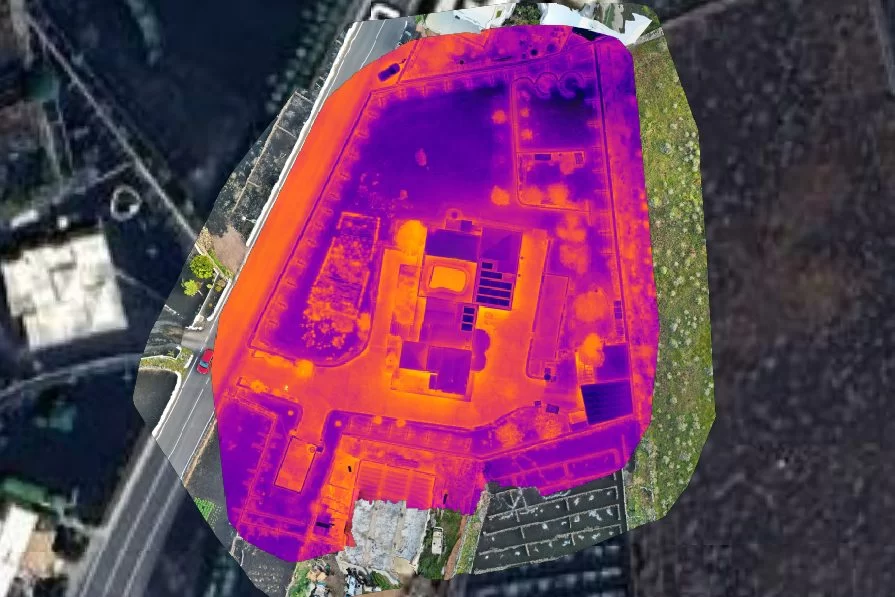
Using Dawn Aerial Thermographic Survey to Identify Subsurface Irrigation Leakage at a Canary Islands Winery Estate
Two hundred and fifty thermograms. Five candidate locations. One primary site with nowhere to hide.
When a Lanzarote winery estate needed to locate subsurface irrigation pipe leakage beneath its stamped concrete entrance drive, conventional detection methods faced a significant challenge: the pipe was buried, the surface intact, and the leak invisible to the eye. Aerial thermography, deployed at dawn after a 24-hour irrigation pre-run, offered a non-invasive route to an answer.
This project documents how a structured collaborative survey between Thermography Services (UK) Ltd and Lanzarote-based drone operator Skynox Drones produced a disciplined, evidence-led assessment — and why the most important work happened not in the air, but in the post-survey scrutiny of every finding.
aerial thermography, leak detection, irrigation survey, drone thermography, Lanzarote, Canary Islands, ISO 18436-7, Level 3 thermographer
The Survey Brief — A Winery, a Buried Pipe, and a Drive that Held Its Secrets
Client, context, and reason for the survey
The project was commissioned by Skynox Drones of Lanzarote, a specialist aerial data and infrastructure inspection operator, on behalf of a winery estate owner in Tinguatón, in the Las Palmas municipality of Lanzarote. The property includes a substantial stamped concrete entrance driveway and associated courtyard areas, beneath which a shallow irrigation pipe network supplies the estate’s planted areas. The owner had identified persistent signs of leakage — including surface staining, localised surface depression, and wet patches — but the precise location of the pipe fault remained unconfirmed. Thermography Services (UK) Ltd was engaged to provide Level 3 thermographic supervision, analysis, interpretation, and certified reporting, with Skynox Drones responsible for aerial data capture using a professional-grade multi-sensor drone platform.
The environment or system being surveyed
The driveway surface is constructed from pattern-imprinted, stamped concrete with a hexagonal design — a thermally uniform, relatively predictable surface well-suited to subsurface thermal analysis. The irrigation system is assumed to comprise small-bore plastic pipework at shallow depth, consistent with standard estate installations in the Canary Islands. The property sits at approximately 226 metres above sea level on Lanzarote’s volcanic landscape, surrounded by lapilli-covered vineyard terraces and ornamental planting. The combination of volcanic substrate, terrace irrigation, established planting, and outbuilding structures in close proximity to the drive meant that confounding thermal sources were a significant interpretive consideration throughout the project.
Survey conditions and preparation
The survey was conducted on 13 March 2026, with the flight window running from 06:37 to 06:56 local time — a carefully selected pre-dawn slot prior to any meaningful solar loading of the drive surface. Environmental conditions were near-ideal: air temperature held stable at 14.1°C across the full survey window, wind speed measured at 0.4 to 0.5 m/s, and relative humidity remained consistent at approximately 69%. A critical element of the pre-survey protocol was the confirmed 24-hour continuous operation of the estate’s irrigation system prior to capture, ensuring maximum sub-base saturation at any leak-affected zones and producing the strongest possible subsurface thermal signal at the time of survey. All radiometric parameters — including a reflected temperature of -20°C appropriate for clear sky dawn conditions — were applied consistently across the full dataset in accordance with ISO 18436-7:2014, ISO 9712:2021, and EN 13187:1999.
Complexity or non-standard element
What made this project technically distinctive was not the survey itself, but the rigour of what followed. An initial analysis produced a candidate dataset of fifteen thermograms across five locations. Before any findings were reported, an extended post-survey RGB review was conducted using oblique and ground-level photography from the site visit, interrogating every candidate location for plausible alternative thermal explanations. This process identified multiple confounding sources — including wall-base vegetation, building exhaust vents, cargo door warm air leakage, and plant pot surface water — that required individual investigation and declaration before thermal evidence could be attributed to subsurface irrigation leakage. The discipline required to downgrade, retain with caveats, or clear each candidate is the hallmark of Level 3 thermographic supervision, and it is what separates a defensible professional opinion from speculative thermal observation.
Survey Scope and Objectives
This project was structured as a professional consultation between Thermography Services (UK) Ltd and Skynox Drones of Lanzarote, a specialist aerial inspection operator with established operations across the Canary Islands. The division of responsibility reflected the complementary competencies of both organisations: Skynox Drones undertook all aerial data collection, operating under a structured Level 1 capture protocol developed under Level 3 supervision and aligned with the principles of ISO 18436-7:2014. Thermography Services (UK) Ltd provided Level 3 thermographic supervision, conducted all analysis and interpretation, and produced the technical report under the Survey, Analysis, and Reporting framework that governs all TSUK project outputs.
The scope was defined around a single primary question: could aerial thermography identify evidence of subsurface irrigation pipe leakage beneath the stamped concrete entrance driveway of a winery estate in Tinguatón, Lanzarote? The estate owner had observed persistent signs of leakage — surface staining, localised depression, and damp emergence — but the precise fault location remained unconfirmed. The driveway and adjacent courtyard areas were designated the primary investigation zone, with surrounding areas reviewed as part of the triage process.
The project forms part of a continuing proof-of-concept programme being developed by TSUK and Skynox Drones to evaluate the application of aerial thermography for subsurface water leak detection across Lanzarote. This programme builds on Phase 1 proof-of-concept work previously conducted at a confirmed urban leak site, which validated the core methodology and established the survey protocols applied here.
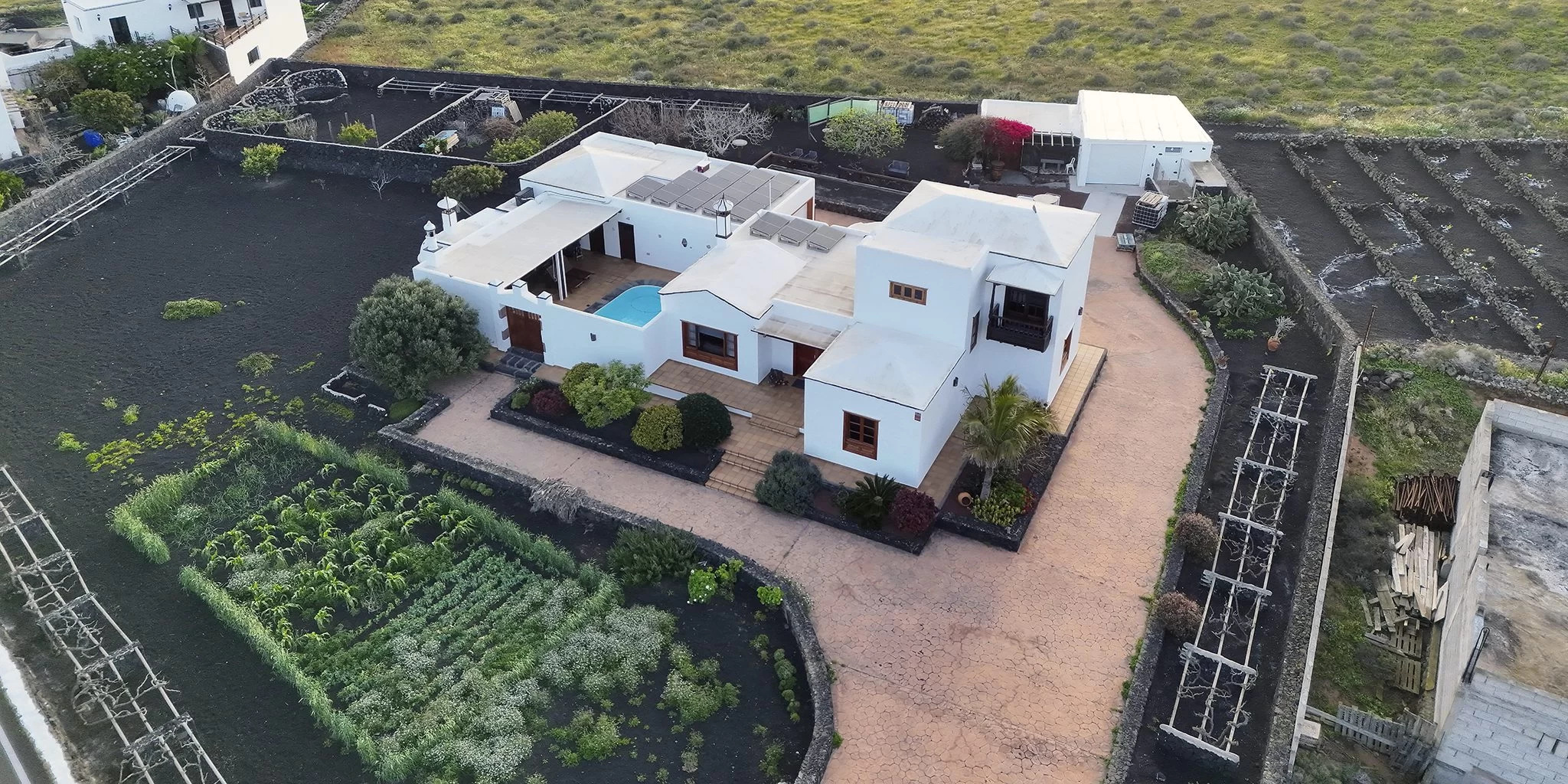
Images provided by Skynox Drones of Lanzarote
The Problem — Why Thermography, and Why It Works Here
The Challenge of Buried Pipework
Detecting subsurface irrigation pipe leaks without excavation is inherently difficult. The pipe is invisible, the leak is gradual, and the surface above it may show only subtle, easily misread signs. Acoustic correlation and pressure testing can indicate a problem exists but often struggle to localise it precisely in complex estate environments with varied pipe materials and routing. Aerial thermography offers a complementary, non-invasive screening approach — but it is only as valuable as the discipline applied to interpreting what is actually seen.
Thermography does not detect water. It detects surface temperature distribution, which may be influenced by what lies beneath. When a buried pipe leaks, the escaping water saturates the surrounding sub-base material, increasing its thermal mass — its capacity to absorb and hold heat. In the hours before dawn, when solar loading is absent and the ground surface has been radiating heat to the cold sky overnight, moisture-affected zones cool more slowly than the surrounding dry concrete. The result, under the right survey conditions, is a subtle warm surface anomaly above the saturated zone that a calibrated radiometric thermal sensor can detect from the air.
Pre-Conditioning and Survey Timing
Two decisions made before the drone left the ground were as important as anything that happened in the air. The first was the confirmed 24-hour operation of the estate’s irrigation system prior to survey. This pre-conditioning period ensured that any leak-affected sub-base zone was fully saturated and carrying maximum thermal mass at the time of capture. A leak that had been running for 24 hours into dry volcanic sub-base would produce a far stronger and more spatially developed thermal signal than one surveyed without preparation.
The second decision was the survey window itself: 06:37 to 06:56, well before any meaningful solar loading reached the drive surface. Under clear sky conditions at dawn, the effective sky temperature is dominated by upper atmospheric emission, producing a reflected temperature in the range of -20°C — a value that was applied as a confirmed radiometric parameter throughout the dataset, supported empirically by a calibration measurement taken from the estate’s unheated, uncovered swimming pool, which returned a corrected surface temperature of 13.0°C against an ambient air temperature of 14.1°C. The pool’s sub-ambient temperature is a direct consequence of overnight radiative cooling to a clear cold sky, and its consistency with the applied Tref gave additional confidence that the radiometric parameter set was well-founded.
Survey Methodology and On-Site Deployment
Environmental Conditions
Conditions throughout the survey window were close to ideal. Air temperature held at a stable 14.1°C from start to finish — a level of consistency that is relatively unusual and eliminates atmospheric drift as a source of interpretive noise. Wind speed measured between 0.4 and 0.5 m/s, effectively calm, which minimises convective disturbance of the surface thermal gradient. Relative humidity was 69%, moderate and consistent, with barometric pressure stable throughout at approximately 986 mb. These conditions are collectively described as near-equilibrium: the surface thermal field at the time of survey was as stable and interpretable as could reasonably be achieved in a field deployment.
Equipment and Data Capture Approach
Aerial data was captured by Skynox Drones using a professional-grade multi-sensor drone platform equipped with a high-sensitivity radiometric thermal sensor and a co-registered high-resolution visible light camera. All thermal imagery was captured in radiometric format, preserving per-pixel temperature data for post-processing correction and analysis. This is a non-negotiable requirement for any thermographic survey intended to produce defensible, measurable outputs. The RGB camera provided concurrent visible-light reference imagery for every thermal frame, enabling systematic visual corroboration of all candidate observations.
The survey was flown at approximately 30 metres above ground level, producing a ground sample distance sufficient to resolve the scale of surface thermal features associated with shallow pipe leakage. Approximately 250 thermal and RGB frames were captured across the full property on a structured grid pattern, with the main driveway zone covered at the highest spatial resolution priority.
Survey Execution
All thermal data was processed within a professional radiometric analysis platform. Environmental parameters — air temperature, relative humidity, reflected temperature, emissivity, and flight altitude — were applied consistently across all frames before analysis commenced. A global emissivity of 0.93 was applied, consistent with the measured properties of the stamped concrete driveway surface. A localised emissivity correction to 0.98 was applied to the swimming pool calibration reference, consistent with the known near-blackbody radiative behaviour of water.
A single colour palette was applied consistently across the dataset to prevent visual bias in interpretation. Thermal span was held at 4 to 5°C throughout the triage pass, tight enough to resolve subtle surface temperature gradients without being dominated by noise. A triage-first approach was adopted: all approximately 250 thermograms were reviewed systematically before detailed analysis began, with candidate frames identified and shortlisted before any measurement tools were placed.
Protocol Development — The Post-Survey RGB Review
The most significant methodological element of this project is one that does not appear in most thermographic assessments: a systematic, post-survey RGB review conducted using oblique and ground-level photography taken during the site visit. This review tested every candidate observation against every plausible alternative thermal explanation before any finding was attributed to subsurface irrigation leakage.
The review identified several confounding sources that were not visible in the aerial RGB data alone: continuous low vegetation growth along the lapilli-adjacent side of the perimeter wall, which produces a dawn thermal signature thermally indistinguishable from a pipe-route moisture gradient at 30m GSD; cargo door warm air leakage from the winery building; surface water from plant pot irrigation at one location; and a wall ventilation aperture. Each confounder was individually investigated and its implications for the adjacent candidate assessment declared. Where a confounder was sufficient to explain a thermal observation independently, the candidate was downgraded. Where it was possible but not conclusive, the candidate was retained with the confounder explicitly documented.
Conversely, two physical indicators discovered during the RGB review strengthened the house-side evidence independently of the thermal data: efflorescence deposits on the lava rock retaining wall, consistent with sustained moisture migration through the masonry, and a localised mid-drive surface staining patch accompanied by a visible surface depression, consistent with sub-base material loss from long-term subsurface water movement.
The Primary Candidate — L-Shaped House Corner and Drive Corridor
The L-shaped house corner and associated driveway corridor is the primary candidate zone in this dataset and the only location where no plausible alternative thermal explanation was identified following full post-survey scrutiny. The zone is supported by the highest thermal differentials in the dataset, the widest spatial coverage across multiple thermograms, independent corroboration from three flight angles, and consistent physical evidence.
At the L-corner junction itself, five independent measurement tools return differentials ranging from +3.4°C to +4.5°C above the concrete baseline under near-equilibrium dawn conditions. The largest single profile differential in the entire dataset — 4.5°C spanning the tiled approach surface — was recorded at this location. A confirmed first-floor balcony above the zone was established as open-sided with no mechanical equipment, excluding building exhaust as a thermal source. No vegetation was present at the house-side measurement surfaces.
Moving along the drive corridor away from the building, the thermal evidence intensifies rather than decays, the opposite of what passive building thermal mass would produce. Peak temperatures of 17.9°C on the open drive surface represent a differential of +5.4°C above the concrete baseline, the highest absolute temperature and the largest anomaly in the dataset. Box measurements taken at progressively closer positions to the L-corner show a systematic thermal intensification, from +1.5°C in the upstream corridor section to +5.4°C at the peak zone — describing a spatial thermal gradient directed toward the corner junction and consistent with an active subsurface moisture source rather than passive retention.
Two reverse-angle flight passes provided independent corroboration from the opposing direction, returning measurements consistent with the primary passes to within 0.1°C. This level of reproducibility across independent capture angles, under near-equilibrium conditions, eliminates view-dependent geometry, specular reflection, and transient surface effects as plausible explanations.
The Secondary Candidate — Outbuilding Ground Zone
A secondary high-confidence candidate was identified at ground level in front of the estate outbuilding, at a location geographically separate from the primary drive corridor. Spot measurements at this location recorded temperatures in the range of 15.2°C to 16.5°C against the concrete baseline, representing differentials of +3.0°C to +4.3°C. The anomaly was confirmed as stable and reproducible through independent multi-angle corroboration, with equivalent measurements from the opposing flight direction consistent to within 0.1°C.
The critical question for this location — whether refrigeration, cold storage, or other temperature-controlled equipment inside the outbuilding could produce the observed ground-level thermal signature, was resolved by examining building roof and elevation temperatures in both capture angles. No elevated thermal signatures were present on the building structure itself, confirming that the outbuilding was thermally ambient at the time of survey and excluding active plant equipment as a plausible heat source. This location is treated as an independent candidate from the primary drive corridor, likely representing a separate section of the irrigation network, and warrants its own targeted ground investigation.
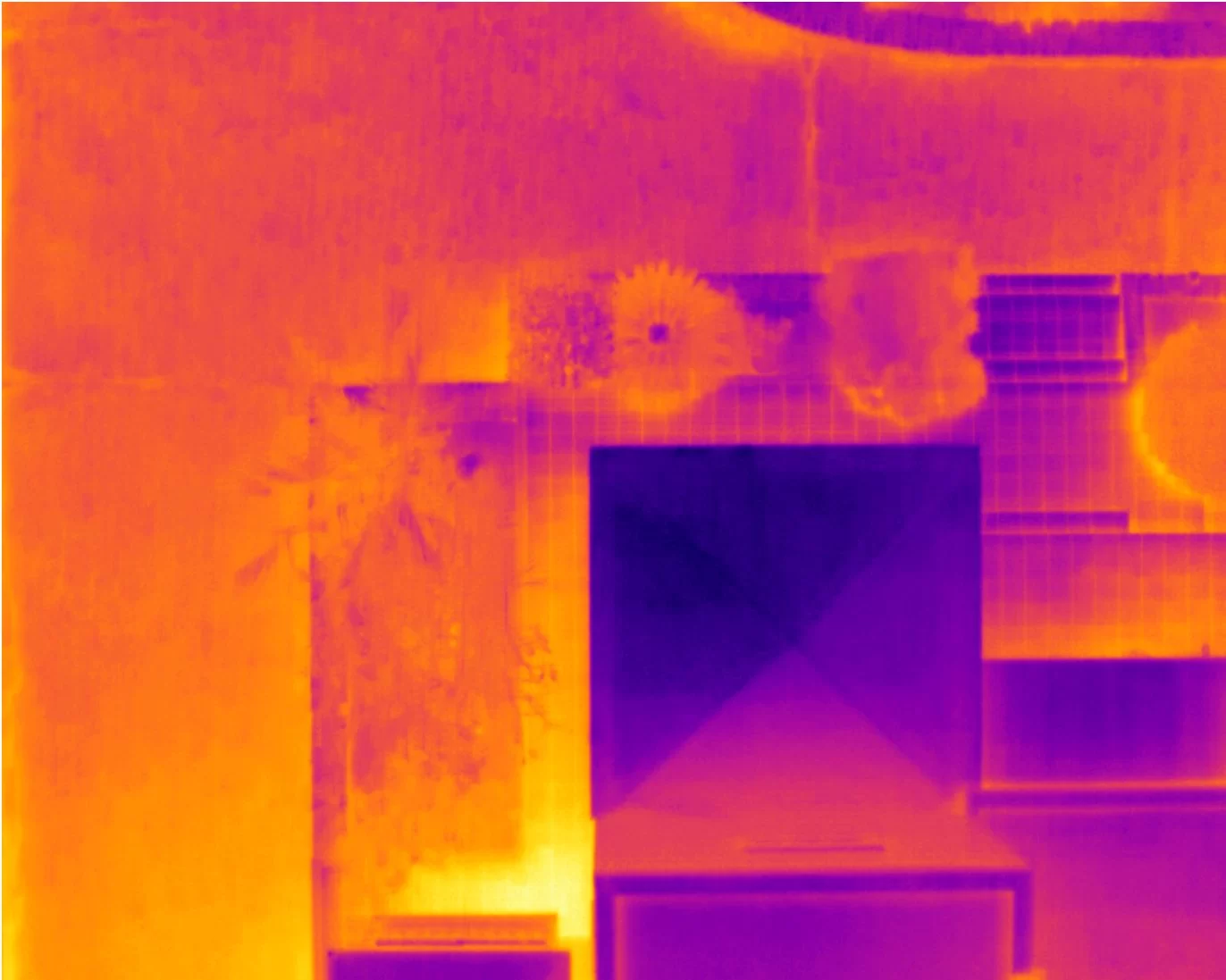
Images provided by Skynox Drones of Lanzarote
What Made This Survey Stand Out
Several elements of this project distinguish it from a routine aerial thermographic survey, and understanding them clarifies what Level 3 thermographic supervision actually means in practice.
The first distinguishing element is the extended post-survey RGB review. Most aerial thermal surveys produce a report based on what the thermal data shows. This project produced a report based on what the thermal data shows after systematically asking — and answering — the question: what else could this be? The process identified confounders that required excluding measurement zones, downgrading confidence classifications, and in some cases fundamentally reconsidering which thermal features were genuine candidates and which were vegetation, building exhaust, or plant pot drainage. That process of elimination strengthened the primary finding immeasurably. A warm zone that survives every alternative explanation carries far greater evidential weight than one that simply looks anomalous.
The second distinguishing element is the use of physical evidence as an independent validation layer. The thermal data alone identified the candidate zones. The ground-level photography provided independent physical corroboration — efflorescence in the masonry, surface staining, and a visible depression consistent with sub-base scour — that neither required nor depended on the thermal evidence to be meaningful. The convergence of two independent evidence streams, each capable of standing alone, produces a finding that is stronger than either would be individually.
The third distinguishing element is multi-angle corroboration applied systematically across the highest-priority candidates. By reviewing the same ground locations from opposing flight directions and comparing measurement values, it was possible to confirm that the strongest anomalies were stable, reproducible, and independent of capture geometry. Anomaly temperatures consistent to within 0.1°C across independent passes, under near-equilibrium conditions, are not noise. They are signal.
The fourth element is the international collaboration model itself. TSUK provided Level 3 analytical authority remotely, working from a structured dataset captured in Lanzarote under a protocol developed for the specific environmental, geological, and infrastructural conditions of the Canary Islands. This model — specialist operator plus Level 3 analytical supervision — is scalable, repeatable, and maintains certification integrity without requiring the thermographer to be physically present at every capture. It is the direction of travel for aerial thermography as a professional discipline.
Outcomes, Reporting, and Next Steps
The deliverable
The project produced a Technical Assessment report under TSUK document reference L0004-TA-002, classified as a professional opinion under Level 3 supervision in accordance with ISO 18436-7:2014 and ISO 9712:2021. The report presents a triage-led summary, detailed candidate site observations across fifteen annotated thermogram pages with radiometric measurements, confidence classifications, and professional annotations, together with a clear summary of findings, declared confounders, and prioritised recommendations for ground investigation. Supporting deliverables include a full-property thermal orthomosaic, RGB orthomosaic, and a QGIS project file enabling swipe-based spatial comparison of the two datasets, providing the estate and its engineers with an accessible, spatially referenced tool for planning any subsequent ground works.
The outcome for the client
The report provides the estate owner and Skynox Drones with a prioritised, evidence-based account of where subsurface irrigation leakage is most likely to be present, and where alternative explanations mean the thermal evidence should be treated with caution. The primary candidate zone at the L-shaped house corner and drive corridor is presented as the highest priority for targeted ground investigation, with a secondary independent candidate at the outbuilding zone. The report does not confirm pipe condition, leak rate, or flow direction — these require physical investigation — but it focuses that investigation efficiently, replacing broad and potentially disruptive exploratory excavation with a targeted, evidence-led starting point.
Broader insight
This project illustrates a model that has significant potential for the systematic management of leakage in water distribution networks and private estate irrigation across Lanzarote and the wider Canary Islands. The combination of controlled dawn survey conditions, 24-hour pre-conditioning, structured triage methodology, and disciplined post-survey RGB review produces a repeatable, defensible analytical framework. Delivered through a collaboration between a local specialist drone operator and a certified Level 3 thermographic consultant, it is a model that scales from private estate irrigation to municipal potable water infrastructure — and the continuing proof-of-concept programme between Thermography Services (UK) Ltd and Skynox Drones is designed to validate and refine exactly that potential.
Thermographic Governance Statement
All thermographic work under this project is conducted in accordance with the competency framework defined by ISO 18436-7:2014 and ISO 9712:2021, under Level 3 supervision certified by the British Institute of Non-Destructive Testing (BINDT). Field data acquisition was guided by principles from IEC 62446-3:2017 and EN 13187:1999, ensuring that environmental conditions, measurement parameters, and reporting structures meet recognised professional standards.
Thermography Report Writing - Across the UK, Europe, and Around the World
Do you need Certified Level 3 Thermography Report for your thermal project?
Our expert consultant delivers fully certified thermography reports for solar, building, electrical, and industrial applications — wherever you operate. We work with clients across the UK, Europe, and internationally, ensuring every report meets recognised standards under ISO 18436-7, ISO 9712, and IEC 62446-3.
Accurate. Certified. Recognised worldwide – Request Your Level 3 Report Consultation Today