
~ Summary ~
Level 3 building thermography survey completed for a high-rise residential block in Edinburgh using drone-mounted thermal imaging and advanced infrared analysis techniques. Thermography Services (UK) carried out a detailed building envelope assessment to investigate insulation continuity, glazing heat loss, thermal bridging, façade performance, and potential roof moisture anomalies across the multi-storey structure. Using calibrated radiometric thermal imaging equipment and controlled survey protocols, the inspection evaluated thermal behaviour across elevations, window systems, roof interfaces, and structural junctions under suitable environmental conditions. Comparative thermal analysis identified localised heat-loss patterns associated with glazing interfaces, mullions, and building envelope transitions while confirming generally strong overall insulation performance.
The resulting Level 3 thermographic reporting provided evidence-based interpretation, annotated infrared imagery, and qualified maintenance recommendations suitable for property managers, developers, and building consultants. This project demonstrates how professional drone thermography supports residential building diagnostics, energy efficiency investigations, preventative maintenance planning, and non-invasive condition assessment for high-rise and multi-storey residential properties.
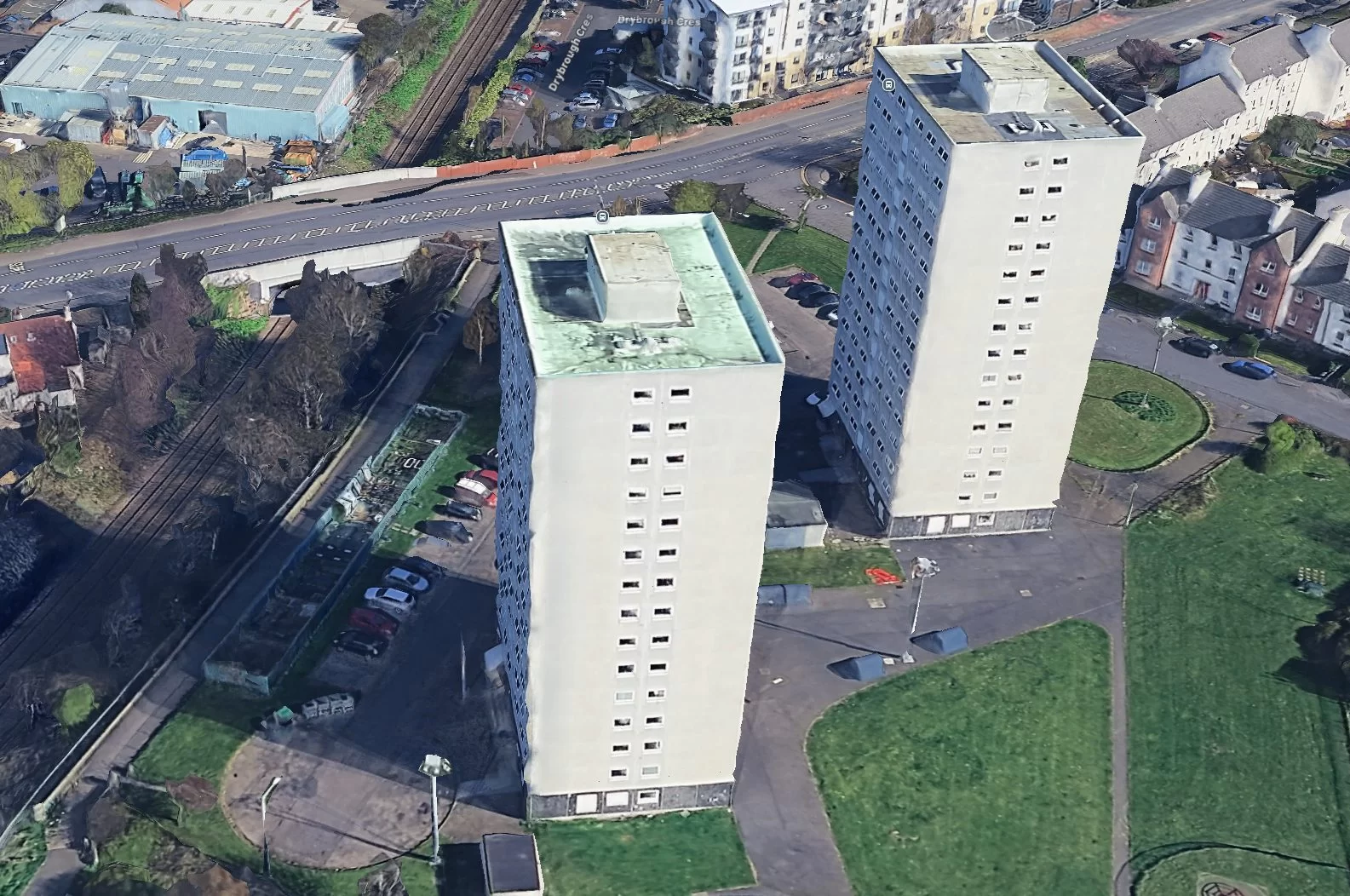
Level 3 Thermography Report Writing, Pre-Refurbishment Building Survey, Edinburgh
A residential asset management organisation required a detailed thermographic condition assessment of a high-rise residential block in Edinburgh ahead of a planned refurbishment programme. Drone-captured thermal and RGB imagery had been collected by a third-party Level 1 operator, and a full Level 3 review, thermogram annotation, and report compilation were required to complete the assessment.
Thermography Services (UK) undertook the analysis under EN 13187 and ISO 6781-3, reviewing 18 thermograms across all four elevations and the roof. The resulting report documented pervasive fabric heat loss, structural thermal bridging at corner junctions, roof moisture indicators, and solar loading behaviour, providing a technically defensible pre-refurbishment baseline.
Pre-Refurbishment Building Thermography Assessment, High-Rise Residential Block, Scotland
building thermography, Level 3 report writing, Edinburgh, pre-refurbishment survey, thermal bridging, moisture ingress, Thermography Services (UK), high-rise residential thermography

Pre-Refurbishment Thermal Assessment, Edinburgh
The building assessed was a multi-storey residential block in Edinburgh, Scotland, constructed in the late 1960s using the Bison pre-cast large panel system. This construction type is widely documented in building pathology literature as presenting one of the most thermally deficient envelopes in the UK residential stock. The solid, uninsulated single-leaf concrete panels carry no cavity, no insulation layer, and no thermal break provision at slab ends or structural junctions. The client, a residential asset management organisation, commissioned the survey as part of a wider pre-refurbishment condition assessment, seeking a thermographic record of the building’s thermal performance prior to planned envelope improvement works.
Thermographic and RGB imagery was captured under controlled post-sunset conditions by a third-party Level 1 drone operator, covering all four principal elevations and the roof in a single sequential capture pass. Thermography Services (UK) was engaged to provide Level 3 review, anomaly classification, thermogram annotation, and full report compilation under its Level 3 report writing service. The engagement follows the Thermography Services (UK) process: survey data review, discussion of scope and methodology, workflow and planning, image-by-image analysis and classification, findings compilation, and delivery of the final certified report.
The survey was conducted in March 2026, approximately one hour and twenty-five minutes after sunset, under clear-sky conditions with an ambient air temperature of 8.0°C and zero recorded windspeed. Clear-sky conditions had material consequences for the thermal signatures recorded on all four elevations and required explicit methodological treatment throughout the analysis, particularly for the south-facing elevation, which carried significant residual solar loading from the day’s irradiance.
How was the building thermography assessment carried out?
The survey was conducted as a non-intrusive, qualitative thermographic assessment in accordance with EN 13187 and ISO 6781-3, with thermographer competence governed by ISO 18436-7 and ISO 9712. Thermal and RGB imagery was captured using a drone-mounted thermal imaging system operated by a third-party Level 1 thermographer, covering all four principal elevations and the roof nadir in a single sequential pass. The Level 1 operator’s dataset was then passed to Thermography Services (UK) for Level 3 review, annotation, and full report compilation under its Level 3 report writing service.
Environmental conditions at the time of capture were assessed as part of the Level 3 review. A clear-sky condition was confirmed independently from the building’s own thermal response, which showed a substantial differential between the solar-loaded south-facing elevation and the radiatively overcooled north-facing elevation, consistent with sustained clear-sky solar irradiance throughout the survey day. An ambient air temperature of 8.0°C with zero recorded windspeed gave an estimated delta-T of 10 to 13°C, at the lower threshold of the minimum recommended by EN 13187, and this limitation was carried through the analysis.
A reflected apparent temperature was derived individually for each thermogram or elevation group using a specular window reference method, providing a calibrated radiometric correction appropriate to the varying drone altitude, camera angle, and sky-to-built-environment view factor ratios across the dataset. A relative anomaly threshold methodology was applied to the west, east, and north elevations, with the working threshold set at the coolest reliably recorded mid-elevation Bison panel reference temperature plus 2°C. The south elevation was assessed descriptively only, as residual solar loading precluded reliable disaggregation of any fabric heat loss signal.
What did the Level 3 review find?
The thermographic dataset confirmed a building envelope of extremely low thermal resistance across all four elevations and the roof. Findings were consistent with the known construction characteristics of the Bison pre-cast large panel system and were assessed using a zonal, comparative approach rather than a conventional discrete-anomaly-led methodology. The entire building fabric presents a continuous heat loss signature, and within this context the analysis identified specific zones of elevated heat flux concentration at structural interfaces.
The predominant wall fabric finding across the west and east elevations was pervasive conductive heat loss through the uninsulated concrete panel field. Against this baseline, the anomaly threshold methodology confirmed a three-dimensional structural thermal bridge at the north-west corner junction, with average values exceeding the west elevation anomaly threshold across multiple thermograms and a maximum recorded value of 8.2°C. The equivalent north-east corner junction was confirmed on the east elevation at a value of 5.7°C, exceeding the east elevation anomaly threshold. Both features are consistent with an uninterrupted concrete-to-concrete heat flux concentration path running the full building height and are classified as Medium severity.
Warm signatures at parapet level were confirmed on all four elevations and corroborated from above by both roof nadir thermograms, consistent with convective heat transfer rising within the uninsulated Bison panel wall and dissipating at the parapet edge. Parapet zone temperatures exceeded the applicable anomaly threshold on the north and east elevations, with readings of up to 4.5°C above the north elevation threshold at the parapet band, classified as Medium severity. These signatures were consistent in both elevation view and nadir view, strengthening the interpretation.
The roof thermograms identified moisture retention indicators across both the south and north halves of the roof surface. On the south half, thermal differentials of up to 12.6°C above the dry field reference were recorded at multiple measurement positions, classified as High severity. RGB imagery confirmed replaced membrane sections on the roof surface, and the junction between original and replaced membrane was identified as the most credible locus for moisture ingress, consistent with water tracking along membrane interfaces on aged bituminous roof systems. The north half presented moisture indicators classified as Medium severity, with differentials of up to 11.6°C above the dry field reference, indicating moisture distributed across the full roof field rather than confined to one area.
Additional findings included air exfiltration signatures at open window and trickle vent positions across multiple thermograms on all heated elevations, a ground floor utility enclosure on the west elevation recording 7.6°C and substantially exceeding the west elevation anomaly threshold, and a clearly documented solar loading sequence on the south elevation with a north elevation control condition confirming the material and orientation basis of elevated south-facing ground floor temperatures.
Need a Level 3 thermography report for your building survey?
Thermography Services (UK) delivers Level 3 thermographic assessment and report writing services for building surveys across the UK, Ireland and Europe, and thermographic consultancy worldwide. Our Level 3 Master Thermographer provides certified, standards-aligned analysis and reporting, whether you have captured thermal data and require it professionally reviewed, or you are commissioning a building survey from the outset. If your project requires Level 3 thermographic oversight, we welcome your enquiry.


