
~ Summary ~
A Level 3 domestic thermography survey of a mid-century bungalow with modern extension revealed consistent loft insulation discontinuity, cumulative window thermal bridging, and junction-level heat loss. Internal and external infrared imaging under controlled winter conditions provided evidence-based insight to support architectural redesign and targeted refurbishment. The inspection identified moderate but widespread inefficiencies, offering a structured foundation for improving thermal performance, comfort, and long-term energy efficiency without intrusive investigation.
Domestic Thermography Survey Reveals Loft Insulation Deficiencies and Junction Heat Loss in Extended Bungalow
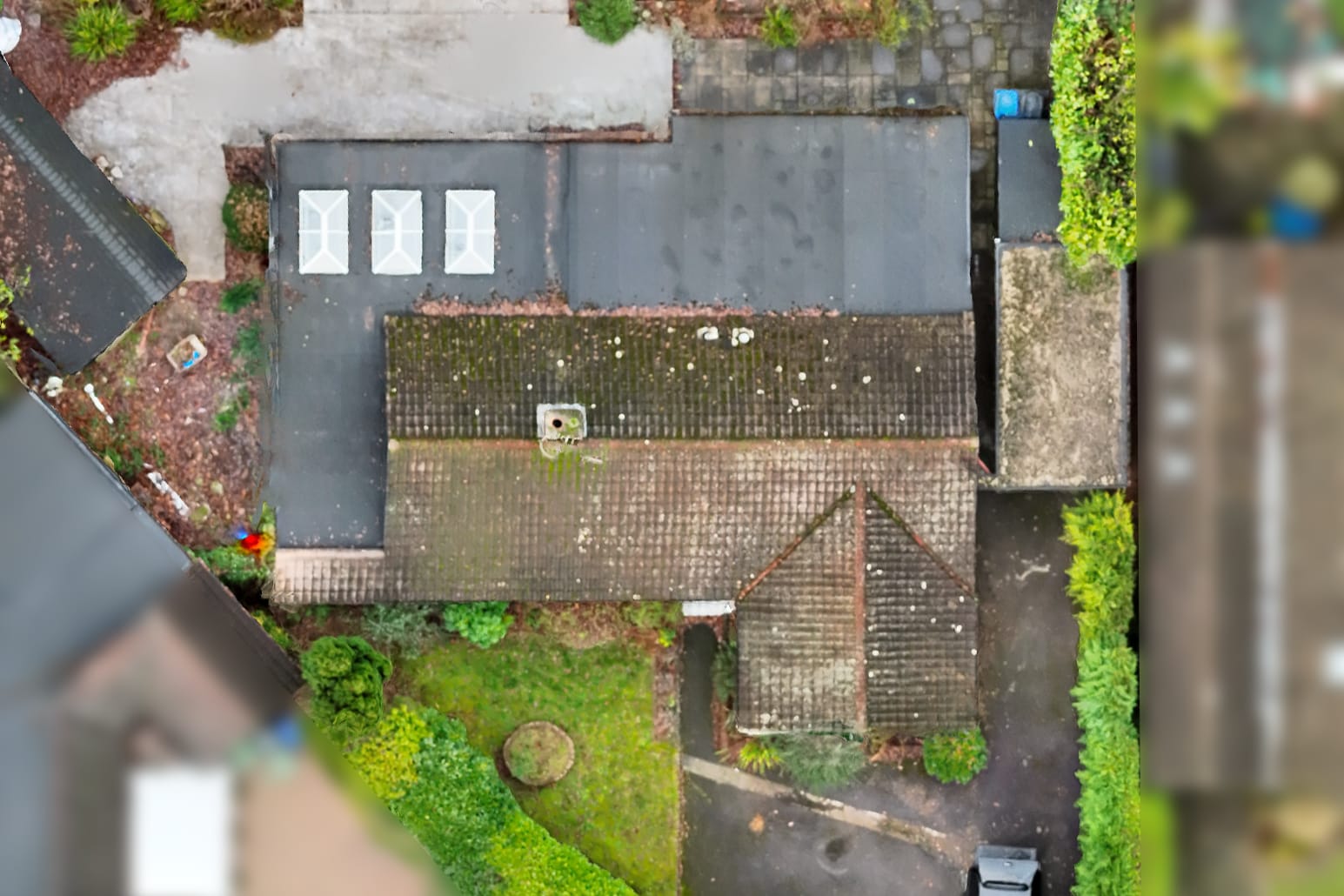
This domestic thermography project involved a detailed internal and external heat loss survey of a mid-20th-century bungalow that had been extended with a modern flat-roof kitchen addition. Commissioned at design stage prior to planned refurbishment, the inspection provided a clear, evidence-based understanding of how the original structure and newer extension were performing thermally.
The survey identified moderate but consistent heat loss at ceiling level due to displaced loft insulation, cumulative thermal bridging at window interfaces, and predictable performance differences between original and extended construction. The findings provided a structured foundation for targeted improvement rather than speculative alteration.

domestic thermography, heat loss, loft insulation, roof insulation, thermal bridging, air leakage, flat roof survey, building performance, Level 3 thermographer, Surrey property
A science-led qualitative thermal inspection supporting architectural redesign and performance improvement in a mixed-construction domestic property.
This project involved a comprehensive qualitative thermographic survey of a single-storey bungalow located in a residential cul-de-sac in the South of England. The property, originally constructed in the mid-20th century, had undergone later alteration, most notably the addition of a flat-roof kitchen and dining extension incorporating rooflights and extensive glazing.
The inspection was commissioned at an early stage of architectural redesign. The property owner and appointed design team sought a measured understanding of existing heating performance, insulation continuity, and any notable anomalies within the building fabric before committing to structural or thermal upgrades. Rather than relying on assumptions based on age or visible construction type, thermography was used to observe how the building was actually behaving under controlled winter heating conditions. As with many mixed-era properties, the bungalow presented as a composite structure. The original pitched tiled roof section, likely dating from the 1950s to 1960s, sits alongside a more modern warm-roof flat extension. Wall insulation type within the original build was unknown, and underfloor heating was installed within the extended kitchen area. These variables made the property particularly suitable for comparative thermal analysis.
The objective was not to “find faults” in isolation. Instead, the goal was to understand patterns of heat movement, identify areas where insulation continuity might be compromised, and assess how construction transitions influenced overall thermal performance. The detailed thermograms were captured using calibrated radiometric equipment and analysed under Level 3 supervision in accordance with recognised professional standards including BS EN 13187 for qualitative detection of thermal irregularities in building envelopes.
How Thermography Is Used and How It Helps
Thermography is a non-intrusive diagnostic technique that visualises relative surface temperature distribution across building elements. All materials emit infrared radiation in proportion to their surface temperature, and calibrated thermal cameras detect and translate this radiation into a visible image. Contrary to common misconception, thermography does not see through walls or roofs. It instead reveals how heat is distributed across surfaces, which in turn reflects insulation performance, air movement, structural bridging, and heating influence.
In domestic buildings, thermography is particularly effective for:
When undertaken under suitable environmental conditions, thermography provides a powerful comparative tool. The key principle is not the absolute temperature reading at a single point, but the relationship between temperatures across similar construction elements. This comparative approach aligns with recognised standards such as BS EN 13187, which defines thermography in buildings as a qualitative method for detecting thermal irregularities.
In this project, thermography offered clarity where visual inspection alone would have been insufficient. Insulation thickness, cavity performance, and loft continuity cannot be reliably judged by appearance. Thermal imaging, when interpreted correctly, reveals where heat is escaping and where building elements behave inconsistently.
Approach and Pre-Project Considerations
Environmental control is fundamental to reliable building thermography. For this survey, internal heating was operated for approximately 24 hours prior to inspection to establish stable conditions. A temperature differential in excess of 10°C between inside and outside was maintained, with internal temperatures between 19°C and 21°C and an external ambient temperature of approximately 6°C.
The property was unoccupied and unfurnished at the time of inspection. While this provided clear visual access to walls and ceilings, it also altered natural convection patterns typically influenced by occupancy and furniture. Internal doors were open, allowing free air movement throughout. The loft hatch was also open during the pre-heating phase, enabling warm air to rise into the loft space and temporarily exaggerating roof-level heat distribution. These contextual factors were recorded and considered during interpretation.
Both internal and external thermographic inspections were undertaken. Internally, all principal rooms were assessed, including the living room, bedrooms, kitchen extension, hallway, and ancillary spaces. Ceilings, window assemblies, door interfaces, and structural junctions were examined. Externally, elevations and roof structures were surveyed to correlate internal findings and confirm roof-level behaviour.
The underfloor heating system within the extension was noted, although detailed performance assessment of the UFH system itself was not within the survey scope. Where thermal patterns were influenced by the floor system, this was interpreted as part of overall building performance rather than analysed as a standalone heating study.
This measured, structured approach ensured that observations were not taken out of context and that environmental influence was controlled as far as practicable.
Key Observations and Findings
Loft Insulation Performance
The most significant and repeatable findings related to ceiling performance within the original pitched roof section. Thermographic patterns across multiple rooms indicated uneven, displaced, or locally missing loft insulation. Warm bands and irregular thermal gradients were observed at ceiling level, particularly near eaves and around service penetrations.
These patterns were not isolated anomalies. They were consistent across different rooms and correlated with physical observation within the loft space. In qualitative thermographic terms, such repeatable patterns strongly suggest reduced insulation continuity rather than random variation. Ceilings represent one of the primary heat loss pathways in domestic properties. Even moderate discontinuity in loft insulation can materially affect heating efficiency and occupant comfort. While no catastrophic failure was identified, the evidence pointed clearly to opportunities for improvement through insulation redistribution or enhancement.
Window and Door Junction Thermal Bridging
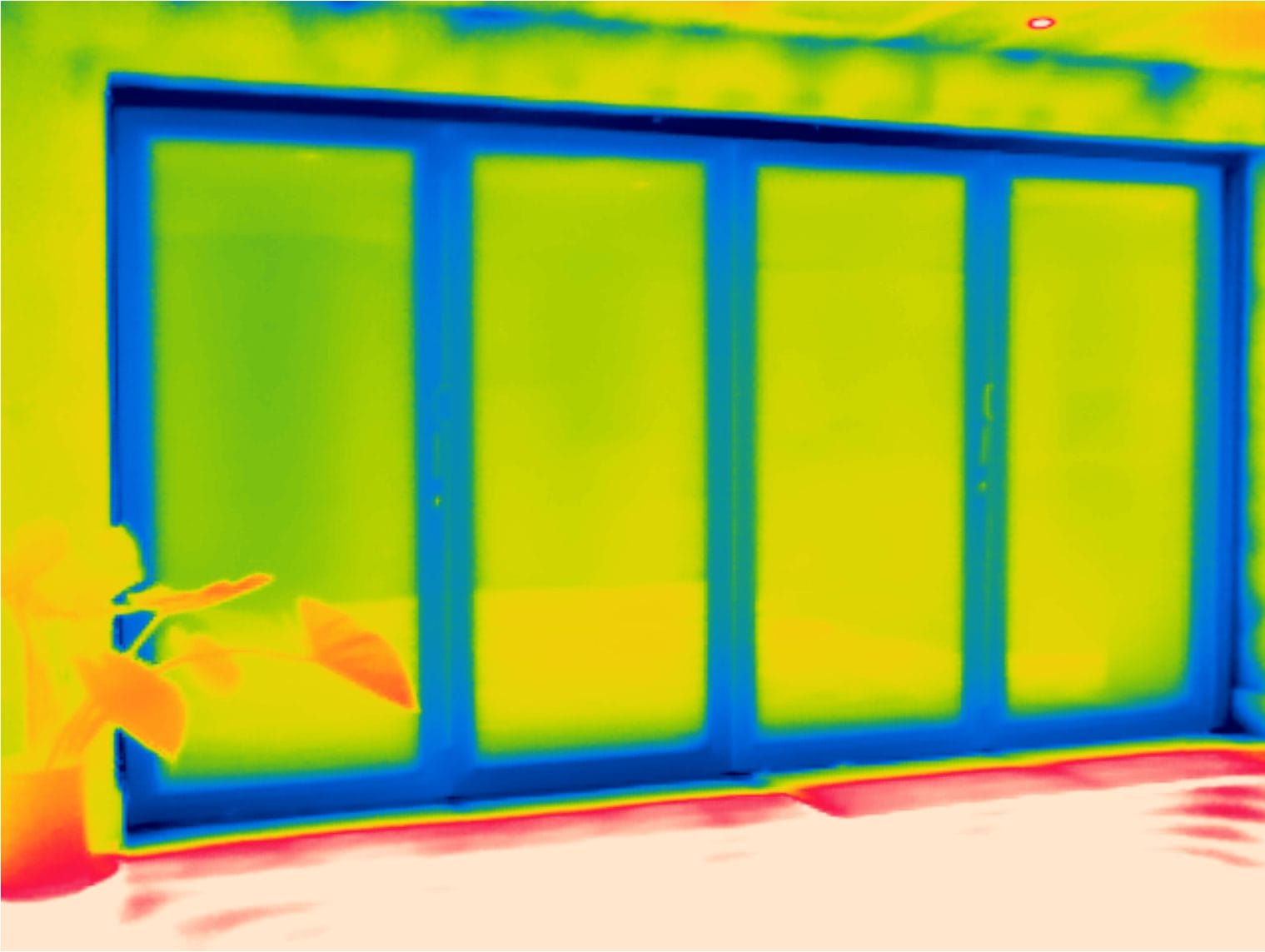
Across all elevations, cooler gradients were observed at frame-to-wall interfaces and within recessed window details. This pattern was consistent in both original and extended sections of the property. Thermal bridging at window heads and reveals is common in properties of this era, particularly where insulation detailing is limited or absent. In this case, the behaviour was cumulative rather than localised. No single opening presented as critical, but taken collectively, the repeated bridging effect contributes to overall heat loss.
Door assemblies exhibited similar behaviour, particularly at threshold and head junctions. These observations are consistent with known building physics principles relating to conductive heat transfer through denser materials and air infiltration at imperfect seals.
Flat Roof and Skylight Performance
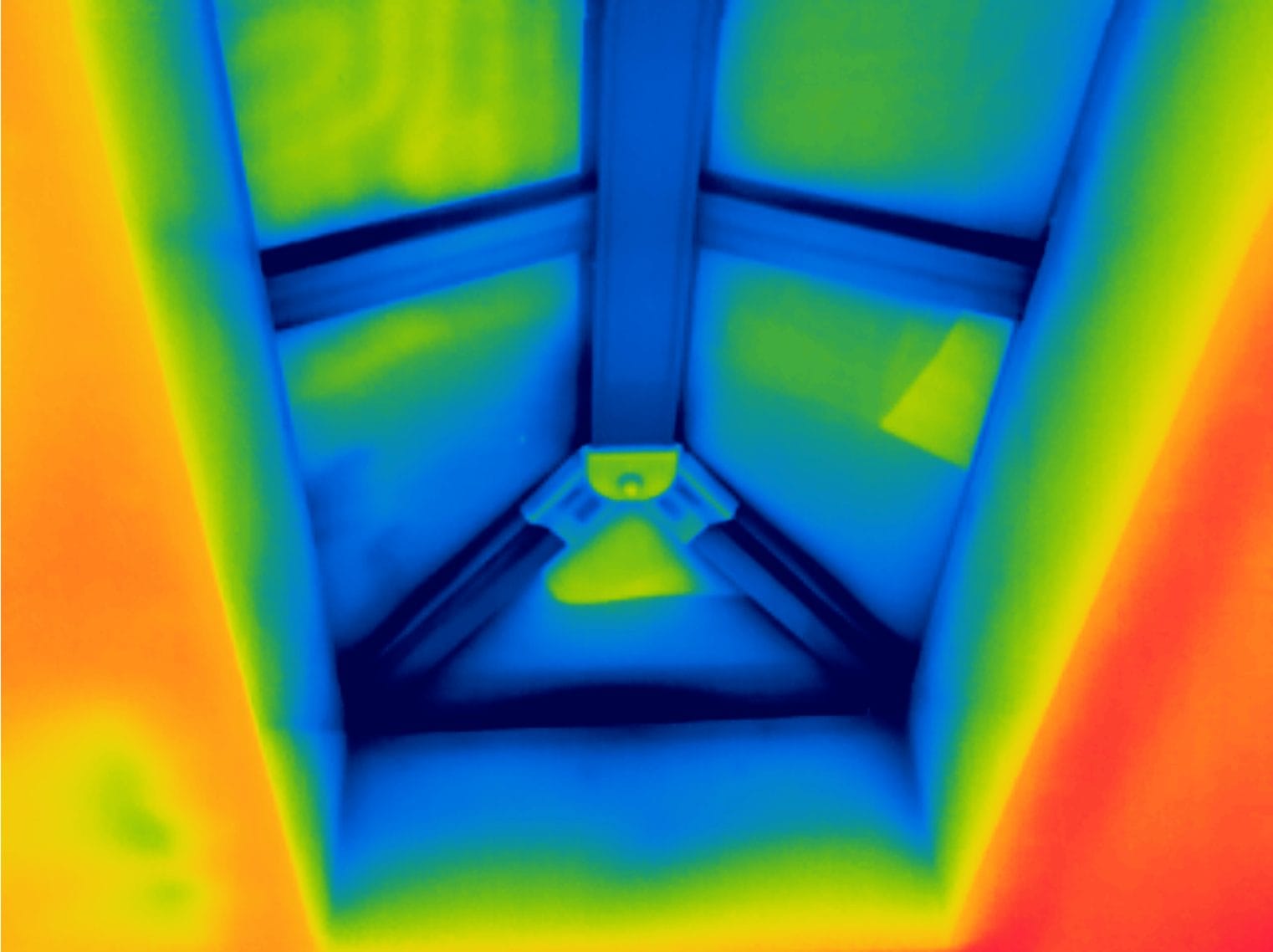
The flat roof extension, assumed to be of warm roof construction, generally performed more evenly than the pitched roof section away from penetrations. However, around rooflights and junction transitions, patchy thermal patterns were observed.
Localised variations around skylight upstands suggested areas of insulation disturbance or detailing complexity. Again, these were moderate in severity rather than critical, but they reinforced the broader theme that junction detailing is often the weak point in otherwise modern construction.
Construction Transition Effects
A clear distinction was evident between the thermal behaviour of the original bungalow and the newer extension. The extension, benefiting from more recent construction standards and integrated underfloor heating, displayed more stable and uniform surface temperatures across large areas. The original structure exhibited greater variability, particularly at ceiling level and around openings. This contrast is typical in mixed-construction properties and highlights the importance of considering the building as a system rather than as isolated elements.
Outcome and Interpretation
The survey did not reveal structural failure or urgent remedial risk. However, it demonstrated that moderate heat loss issues were widespread and repeatable, particularly at ceiling level and around openings. These are precisely the types of inefficiencies that often go unnoticed until refurbishment or energy upgrade works are contemplated.
Importantly, thermography provided clarity without speculation. Rather than assuming poor insulation based on age, the survey demonstrated where insulation continuity was likely compromised. Rather than assuming modern extension performance was flawless, it highlighted junction-level detail that could be refined.
For the design team, this information supports informed decision-making. Loft insulation improvement can be prioritised. Window junction detailing can be reviewed. Flat roof skylight interfaces can be assessed before decorative finishes are altered. Thermography transforms refurbishment planning from assumption to evidence-led strategy.


