
Electrical distribution board thermography survey completed to support insurance compliance, preventative maintenance, and electrical risk management within a commercial environment. Thermography Services (UK) carried out a detailed infrared inspection of live electrical systems using calibrated thermal imaging equipment and Level 3 thermographic analysis techniques. The survey assessed distribution boards, breakers, switchgear, cable terminations, and load-related thermal anomalies that may indicate loose connections, phase imbalance, overload conditions, component deterioration, or developing electrical faults.
By undertaking inspections under operational load conditions, the thermographic survey enabled non-invasive identification of potential failure points before escalation into unplanned downtime, fire risk, or equipment damage. The resulting thermal inspection report provided prioritised findings, radiometric imagery, engineering interpretation, and actionable maintenance recommendations suitable for insurers, facilities managers, and compliance documentation. This project demonstrates how professional electrical thermography supports predictive maintenance programmes, reduces operational risk, improves electrical safety, and assists businesses in meeting insurance inspection requirements through condition-based monitoring and early fault detection.
Industrial Electrical Thermography Survey for Insurance Compliance Across Seven Distribution Boards
An insurance-led electrical thermography survey was conducted across seven distribution boards within a commercial production environment. The objective was to identify abnormal thermal conditions that may present elevated fire or operational risk, using Level 3 supervised infrared inspection in accordance with recognised standards. The survey identified predominantly normal operating conditions, with limited advisory-level observations relating to localised protective device heating under load. No critical anomalies were detected.
A structured, science-led infrared survey demonstrating how professional thermography supports insurance compliance, risk management and preventative maintenance in commercial electrical installations.
Electrical thermography, Distribution board survey, RCBO heating, Insurance inspection, Infrared electrical survey, Condition monitoring, Level 3 thermographer, Commercial electrical panels, Thermal anomaly detection, Preventative maintenance
Electrical Distribution Board Insurance Inspection
Electrical distribution boards are one of the most common ignition sources in commercial fire investigations. Insurers increasingly require periodic infrared thermographic inspection to demonstrate that panels are not operating under abnormal thermal stress. In this project, Thermography Services (UK) was instructed to conduct a structured electrical thermography survey across seven distribution boards within an industrial production environment. The objective was clear, to screen for abnormal heating patterns that may indicate developing faults, high-resistance connections, overload conditions or imbalance, without extending into electrical testing or remedial activity.
The survey was undertaken using a FLIR T-series thermal imaging camera under controlled conditions, with parameters documented for emissivity, reflected temperature, ambient temperature and relative humidity. Each board was assessed comparatively, identifying baseline device temperatures and measuring differential spans across phases, neutrals, RCBOs and outgoing conductors. Observations were interpreted under Level 3 supervision in accordance with ISO 18436-7:2014 competency framework. The methodology aligns with established industry guidance for electrical condition monitoring and loss-prevention inspections.
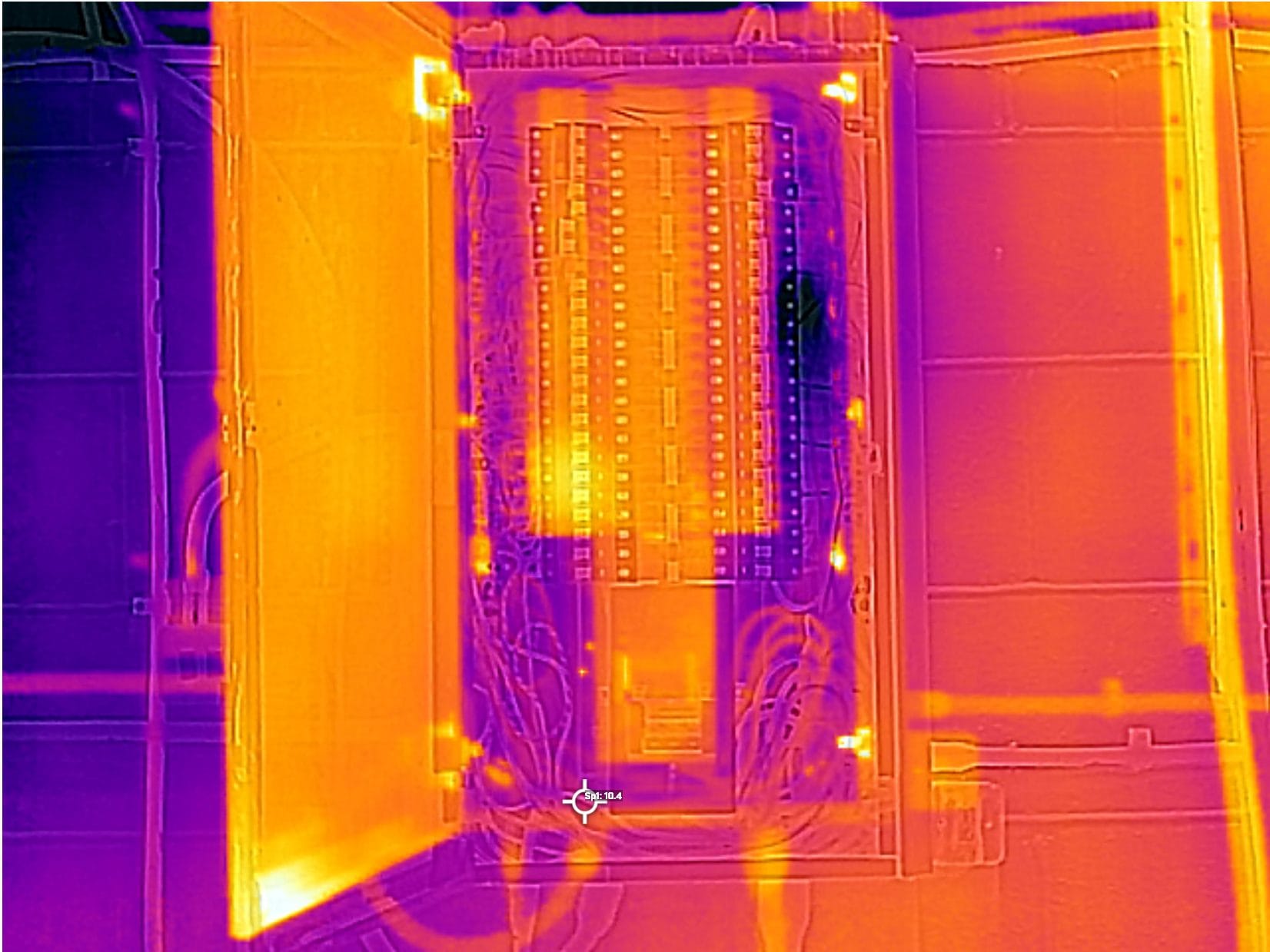
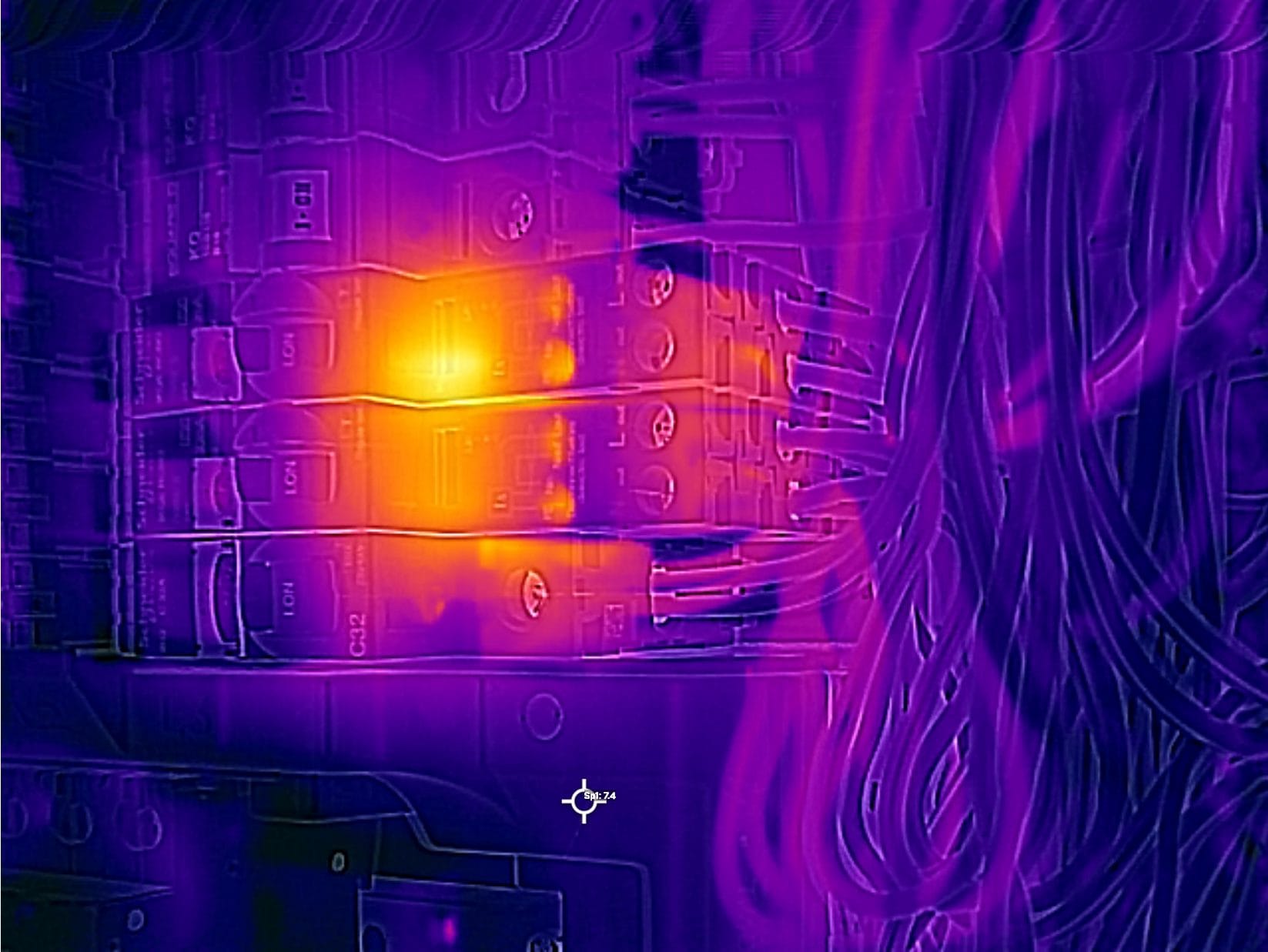
Across all seven distribution boards, thermal behaviour was predominantly uniform and consistent with normal operational loading. One protective device, a B20 RCBO supplying a high-demand test bench, exhibited elevated surface temperature relative to adjacent devices. Detailed close-up imaging confirmed temperature spans consistent with load-related heating rather than connection failure or insulation breakdown. No evidence of loose terminations, phase imbalance, neutral overheating or busbar distress was identified. The overall condition was categorised as acceptable with limited advisory observations only.
How Thermography Is Used and How It Helps
Infrared thermography detects surface temperature variation caused by electrical resistance and load-induced heating. When current flows through a conductor, heat is generated proportionally to resistance and current squared, described by Joule’s law. Under normal operating conditions, this heating is predictable and uniform. Abnormal heating, particularly when localised, asymmetrical or disproportionate to load, may indicate high-resistance connections, deteriorating terminations, imbalance, insulation failure or overloading.
Unlike intrusive testing, thermography is non-contact and performed under live operating conditions. This makes it uniquely suited to insurance-driven inspections, where systems must remain energised. The technique is comparative rather than absolute. A temperature of 24°C may be normal in one context and abnormal in another. What matters is the differential against comparable components under similar loading.
Industry best practice, reflected in standards such as ISO 18436-7 and recognised by the British Institute of Non-Destructive Testing, emphasises interpretation under competent supervision. Thermography does not replace electrical testing, nor does it certify compliance under BS 7671. Instead, it provides condition-based evidence of thermal behaviour, supporting preventative maintenance and risk mitigation.
Approach and Pre Project Considerations
Prior to inspection, the scope was clearly defined to meet insurer requirements. The survey was positioned as a thermal condition screening exercise rather than an electrical installation condition report. This distinction is critical in professional practice, as thermography evaluates thermal performance only and does not verify protective device coordination, earthing integrity or cable sizing compliance.
Environmental parameters were recorded at each inspection stage to ensure defensible data capture. Reflected apparent temperature was measured and incorporated into camera settings. Emissivity values were selected appropriately for polymer enclosures and metallic surfaces. Where reflective metal components were present, interpretation accounted for potential reflection artefacts, and such instances were explicitly annotated within the FLIR reports.
Loading conditions were observed at the time of inspection. While amperage readings were not taken, conductor temperature gradients were evaluated comparatively across phases. Particular attention was paid to:
This structured methodology ensured consistency across all seven distribution boards.
Key Observations and Findings
The majority of devices across the inspected distribution boards demonstrated uniform thermal behaviour within expected operational ranges. Temperature differentials between adjacent MCBs and RCBOs were typically within a narrow span, suggesting balanced load distribution and sound termination integrity.
One RCBO supplying a production test bench presented elevated casing temperature relative to adjacent devices. Close-up thermal imaging revealed surface temperatures approximately 6–8°C above neighbouring protective devices. Importantly, heating was distributed across the body of the device and outgoing conductors, rather than concentrated at a single termination screw. This pattern is characteristic of load-related heating rather than high-resistance fault conditions.
Phase inputs across the same board showed consistent temperature distribution. A measured span of approximately 4°C between protective devices C16 and C32 was observed, with associated conductors demonstrating proportional warming. The absence of hotspot concentration at termination points reduces the likelihood of loose connection or contact degradation.
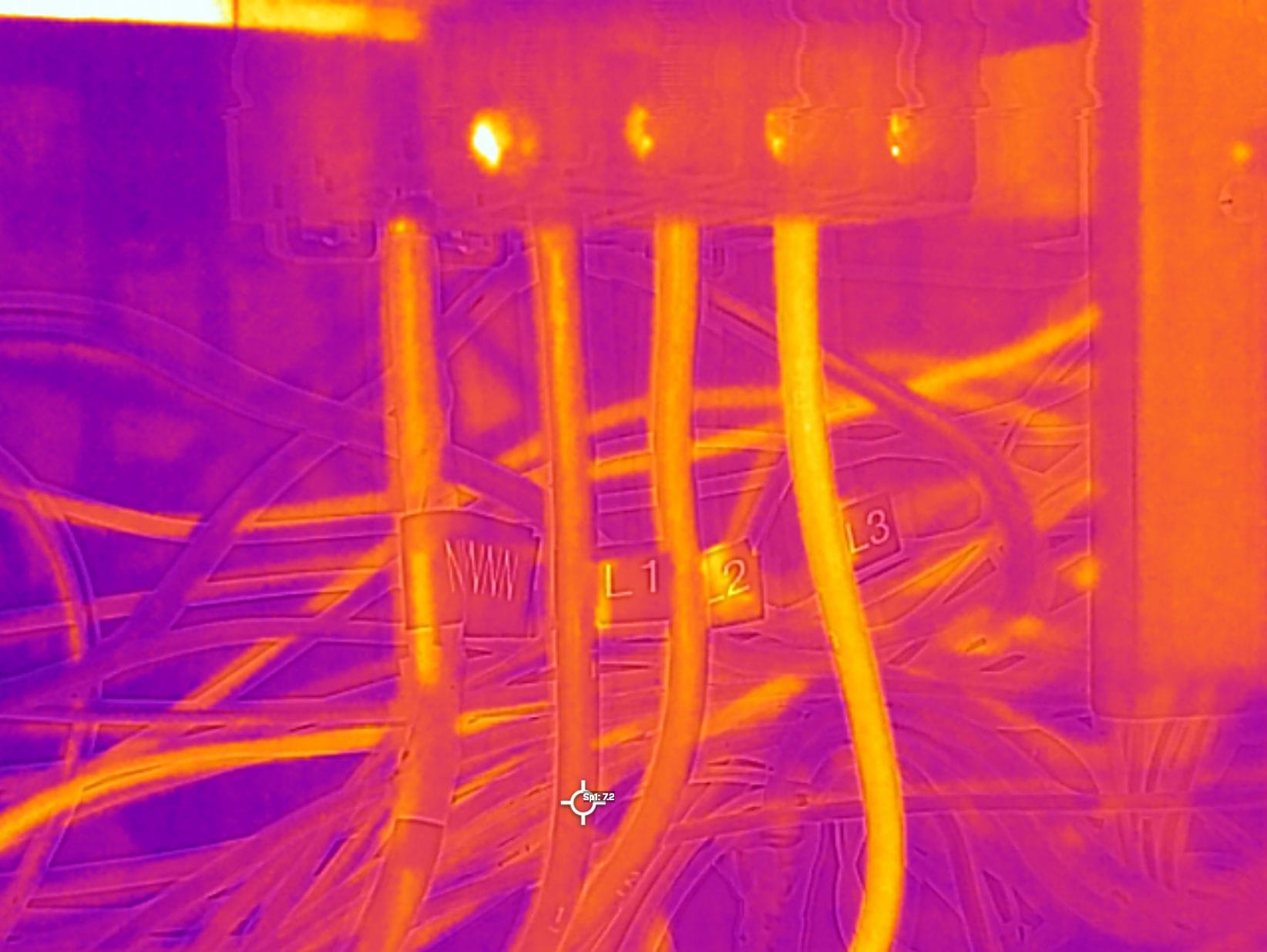
No significant neutral overheating was detected. Neutrals remained proportionate to phase conductor temperatures, suggesting absence of harmonic overload or imbalance. Busbar structures displayed consistent thermal distribution, and no localised overheating indicative of contact resistance was identified.
Across all boards inspected, no conditions met criteria for urgent intervention. Advisory categorisation was applied only where protective device heating exceeded baseline by a measurable but explainable margin.
Outcome and Interpretation
From an insurance and risk-management perspective, the outcome of this survey was positive. The electrical infrastructure demonstrated stable thermal performance under operational load. Where elevated temperatures were identified, they were consistent with expected loading conditions rather than progressive fault development.
The structured interpretation framework is important here. Thermography is frequently misunderstood as a fault-finding guarantee. In reality, it is a condition monitoring tool that identifies thermal anomalies requiring further investigation where appropriate. In this case, the absence of abnormal asymmetry, concentrated terminal heating or excessive differential span indicates that the installation is operating within expected parameters.
The advisory classification applied to the RCBO under higher demand is appropriate and proportionate. It signals awareness without exaggeration. Continued periodic monitoring as part of a preventative maintenance programme would provide trend analysis and early detection should conditions change.


